
North aisle window - Braunston, Northamptonshire
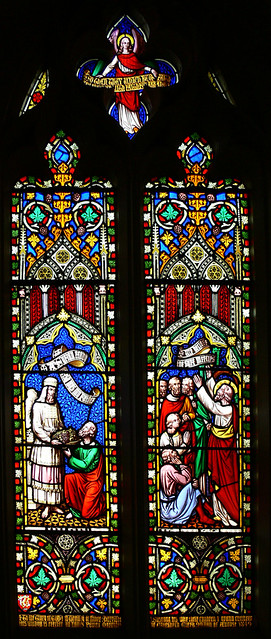
This two-light window by William Wailes presents a moral and scriptural programme concerned with faith, obligation, and proclamation, expressed through paired Old Testament imagery and biblical texts.
Left-hand light:
The scene depicts Giving tithes, illustrated by figures presenting offerings. The accompanying inscription, “A Syrian ready to perish was my father” (Deuteronomy 26:5), forms part of the liturgy associated with the offering of first fruits, linking material gift-giving to remembrance of God’s providence and covenantal faithfulness.
Right-hand light:
The opposing scene represents Preaching, with a central figure addressing a gathered group. The inscription, “We declare thy sure mercies” (Isaiah 55:3), emphasises the proclamation of divine promise, balancing the act of material offering in the left-hand light with the spoken transmission of faith.
Tracery light:
Above the main lights, an angel bearing a scroll displays the text “So then they which be of faith shall be blessed with faithful Abraham ⓘ” (Galatians 3:9). This inscription provides the theological key to the window as a whole, uniting the acts of giving and preaching under the overarching theme of justification and blessing through faith.
The window is characteristic of Wailes’s mid-nineteenth-century work, combining strong colour contrasts, expressive figure groupings, and prominent textual elements. The clear narrative structure and emphatic inscriptions reflect the didactic aims of early Victorian stained glass, intended to communicate scriptural teaching directly and intelligibly to the parish congregation.
Executed just over a decade after the Tithe Commutation Act ⓘ of 1836, which converted traditional payments in kind into monetary sums based on the price of corn, the window’s emphasis on Giving tithes acquires a contemporary resonance. By presenting tithe-giving through an Old Testament image of offering first fruits, the design recalls an older, visibly enacted form of obligation rooted in scripture and custom. In doing so, it reaffirms the moral and theological foundations of giving at a moment when the legal and economic basis of tithes had recently been transformed.