
Morris, William
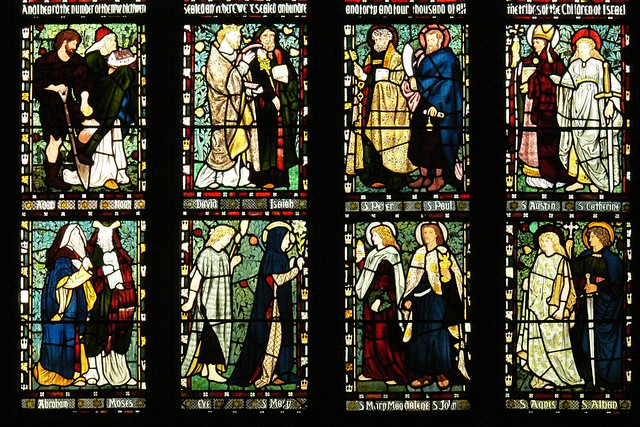
William Morris (1834–1896) stands as one of the central figures in the revival of British stained glass during the second half of the nineteenth century. Through the firms Morris, Marshall, Faulkner & Co. and later Morris & Co., his designs — and those of his close collaborators, especially Edward Burne-Jones ⓘ, Ford Madox Brown, and Dante Gabriel Rossetti — transformed the visual language of Victorian church decoration.
Morris’s windows are celebrated for their intense, jewel-like colours, elongated Pre-Raphaelite figures, and dense patterned foliage, which combine medieval inspiration with modern artistic sensibilities. They are among the finest examples of the Arts & Crafts movement.
Characteristics of Morris Stained Glass
1. Colour and Glass Quality
-
Use of deep ruby, sapphire blue, and emerald green
-
Heavy reliance on antique glass and hand-cut quarries
-
Strong black linework allowing for graphic clarity at distance
-
A conscious rejection of Victorian “machine brilliance” in favour of medieval glass textures
2. Figures and Style
Although Morris designed some figures himself, the overwhelming majority are by:
-
Edward Burne-Jones, whose tall, lyrical figures with introspective faces dominate the firm’s output
-
Ford Madox Brown, supplying muscular prophets and patriarchs
-
Rossetti, contributing early expressive female saints and angels
Typical traits include:
-
Drapery with broad, sweeping folds
-
Faces with gentle melancholy or inward contemplation
-
Medievalising costumes rather than classical robes
-
Graceful, often elongated proportions
3. Decorative Surrounds
Perhaps Morris’s greatest contribution is the glass ornamentation:
-
Dense foliage borders, acanthus, hawthorn, oak, and honeysuckle
-
Quatrefoil ⓘ, diaper, and botanical patterns inspired by medieval English glass
-
Repeated motifs seen across the firm’s tapestries and textiles
4. Iconographic Approach
Morris windows generally emphasise:
-
Narrative clarity (simple scenes, minimal extraneous architecture)
-
Saints and prophets, often arranged as tall standing figures
-
Typological pairings matching Old and New Testament themes
-
Angels with patterned wings and flowing hair
Burne-Jones’s designs for the Adoration of the Magi, Annunciation, Christ in Majesty, and numerous archangel figures became some of the most reproduced cartoons in the history of British stained glass.
Historical Context
Early Period (1861–1875)
Windows from the early partnership exhibit a distinctly Pre-Raphaelite richness. Figures by Rossetti or Brown are more dramatic and often have heavier modelling. Quarries may be more varied, borders more experimental.
Morris & Co. Period (1875–1940)
After Morris restructured the firm under his sole ownership, Burne-Jones became dominant.
These later windows typically show:
-
Lighter, airier palettes
-
Leaner, more idealised figures
-
More standardised borders and quarry patterns
-
A strong emphasis on angelic and visionary themes
By the late nineteenth century Morris & Co. were among the most sought-after glassmakers in the English-speaking world, with commissions from Britain, America, Australia, South Africa, and Canada.
A biography of William Morris can be found on the website of the William Morris Society.
