Madox Brown, Ford
Ford Madox Brown was born on 16 April 1821 in Calais to English parents, and received his artistic training at the Académie des Beaux-Arts in Antwerp, where the rigorous academic tradition left a lasting imprint on his draftsmanship and compositional discipline. Though Brown spent much of his early life moving between the Continent and England, he established himself in London during the 1840s as a painter of historical and moral subjects.
In 1848, Brown met Dante Gabriel Rossetti and William Holman Hunt, whose newly formed Pre-Raphaelite Brotherhood sought a radical renewal of British art through intense colour, precise realism, and a return to early Renaissance clarity. Brown never formally joined the Brotherhood, yet his work was quickly recognised by critics and the public as sharing its key characteristics. His paintings—rich in narrative content, emotional charge, and social engagement—became closely associated with the wider Pre-Raphaelite movement.
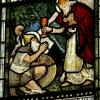
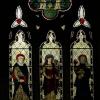
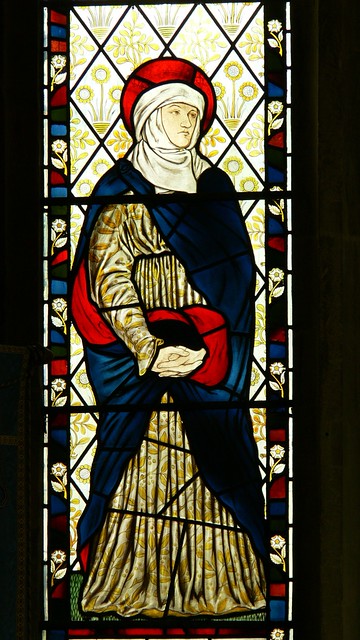
Brown’s connection with William Morris deepened in 1861, when he became one of the founding designers for Morris, Marshall, Faulkner & Co. His contributions included book illustrations, cartoons for stained glass, and decorative schemes that reveal the same careful draughtsmanship and narrative clarity found in his paintings. Though not as prolific a glass designer as Burne-Jones ⓘ, Brown’s stained-glass figures are notable for their expressive character and sculptural solidity.
Ford Madox Brown died on 6 October 1893, leaving behind a distinctive body of work that bridges early Victorian historical painting and the later Arts and Crafts revival. His influence lived on not only through the Pre-Raphaelite circle but through his daughter Lucy and his adopted son Ford Madox Ford, both of whom shaped English cultural life in the later nineteenth and early twentieth centuries.