
Scarabaeidae
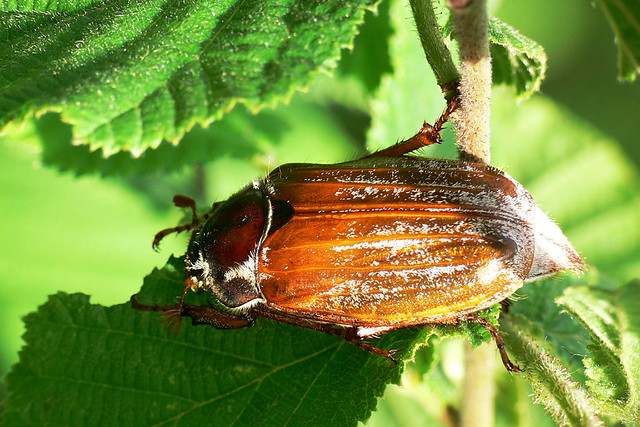
The Scarabaeidae is a large and diverse family of beetles characterised by robust, oval bodies, lamellate antennae with a fan-like club, and strong forelegs adapted for digging. Colours vary widely from dull brown to metallic, with many species exhibiting smooth, compact forms. Males of several groups show horns or other exaggerated structures used in competition.
Biology
Adults feed on a wide range of materials including decaying plant matter, dung, fungi, living foliage, or tree sap, depending on subfamily. Larvae are typical C-shaped grubs, developing in soil, decaying wood, dung, or plant roots. Many species play an important ecological role in decomposition and nutrient recycling.
Diversity
A globally distributed family with more than 30,000 species, including dung beetles, chafer beetles, rose chafers, rhinoceros beetles, and May/June beetles. The group is especially diverse in warmer regions but is well represented in Europe.
Identification
- Antennae ending in a lamellate, movable club
- Often stout, domed bodies
- Strong tibiae with teeth for burrowing or manipulating substrate
- Larvae C-shaped, cream-coloured with a brown head
Ecology and Importance
Scarabaeidae include key ecosystem recyclers such as dung beetles, as well as several economically important pests of turf and crops. Many species are strong fliers and show seasonal activity peaks in spring or summer.

