Sarah Baroness Braye Tomb - Stanford-on-Avon, Northamptonshire
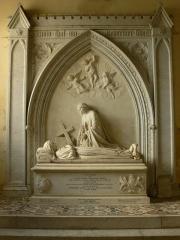
Tomb in memory of Sarah Baroness Braye (d1862) by Mary Thorneycroft ⓘ.
Tomb in memory of Sarah Baroness Braye (d1862) by Mary Thorneycroft ⓘ.
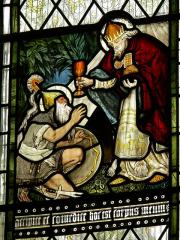
The south window of the chancel at All Saints, Middleton Cheney, contains two important stained-glass panels designed by Ford Madox Brown in 1870, created during his period of work for Morris, Marshall, Faulkner & Co. These windows are among the finest surviving examples of Brown’s contribution to Victorian ecclesiastical glass, characterised by his expressive figures, sculptural modelling, and dense narrative detail.

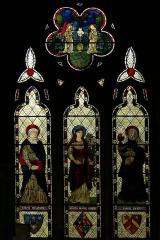
Medieval panels dated between 1330-1350 of three saints.
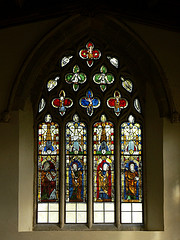
St Anne teaching Virgin to read, St. Agnes ⓘ, and other female saints. Early C14 (1330-1350).
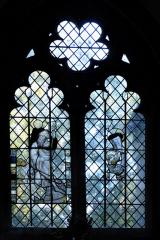
This two-light stained glass window, dating to around 1410, combines two devotional subjects of late medieval popularity: Saint Christopher in the left-hand light and Saint Anne with the Virgin Mary ⓘ in the right-hand light. The pairing reflects contemporary concerns with protection, instruction, and the visible presence of holiness in everyday life.
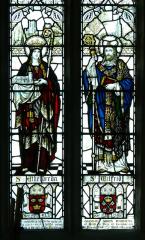
This two-light stained glass window, by J. Powell & Sons (Whitefriars), designed by J. W. Brown ⓘ, depicts St Etheldreda ⓘ and St Wilfrid ⓘ, rendered as standing full-length figures beneath delicately patterned Gothic canopies.
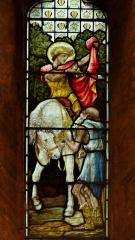
This stained-glass window of 1883, made by J. Powell & Sons (Whitefriars), is located in the church at Litchborough. It depicts St Martin ⓘ of Tours on horseback sharing his cloak with a beggar — one of the most enduring episodes of late Roman Christian legend.


Three female saints 1330-1350. Two are unidentified the middle figure is that of St. Agnes ⓘ.

Wall paintings of St Christopher.
The north-aisle east window at Middleton Cheney contains two major stained-glass figures designed by Ford Madox Brown in 1880 for Morris, Marshall, Faulkner & Co. These works represent some of Brown’s finest ecclesiastical contributions and exemplify his distinctive approach to figural design, which differs markedly from that of colleagues such as Burne-Jones ⓘ.