Saints

15th century wooden Apostles - Dunstable Priory

15th century wooden Apostles - Dunstable Priory

These carved oak Apostles at Dunstable Priory form part of the structural and iconographic programme of the timber roof, functioning as corbels supporting arched braces or hammer-beams. Oak, the standard and most durable timber for English ecclesiastical roofs, was universally favoured for such work, allowing both structural strength and detailed carving.



Archbishop Thomas Becket of Canterbury

Thomas Becket was one of the most powerful and controversial ecclesiastical figures of the twelfth century. His career illustrates the tensions between royal authority and the autonomy of the Church in Angevin England, while his death transformed him from royal servant and archbishop into an international martyr and focus of pilgrimage.

Birth of the Virgin Mary and Childhood


The first sequence of sculpture around the choir screen, starting at the western end of the south ambulatory, is the work of Jehan Soulas from 1519-1521. Sculpted from the hard limestone from the Tonnerre quarry, they consist of scenes from the Gospel of James, depicting the annunciation of the Virgin Mary to Joachim and St Anne, the birth of Mary, and the presentation of Mary in the temple.


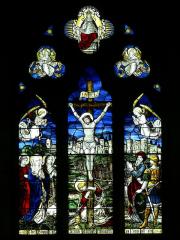
Crucifixion - Whilton, Northamptonshire

Crucifixion - Whilton, Northamptonshire

This east window presents a compact yet richly articulated Crucifixion composition, arranged across three principal lights beneath a tier of tracery lights. it is typical of late-Victorian Gothic Revival glass, and demonstrates Burlison & Grylls’ characteristic clarity of drawing, strong colour harmonies, and careful architectural setting.

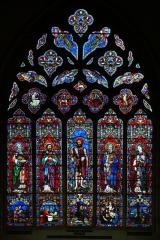
East Window - Crick Northamptonshire

East Window - Crick Northamptonshire

The east window of the parish church of St Margaret, Crick, is a large multi-light stained-glass composition dated 1857, by Lavers & Barraud1, and predates the appointment of Nathaniel Westlake as principal designer at the firm. Occupying the principal liturgical position, the window presents a carefully structured theological programme combining figures of prophecy, witness, and redemption.

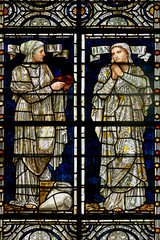
Faith, Devotion, and Courage: The Biblical Women of Henry Holiday

Whitefriars Stained glass by Henry Holiday in  Salisbury Cathedral

The four stained glass panels designed by Henry Holiday and made by James Powell & Sons (Whitefriars Glass) in 1891 form one of the most refined and spiritually resonant decorative ensembles in Salisbury Cathedral. Conceived as a unified series, they portray eight women of Scripture, Sarah and Hannah, Mary the Virgin and Mary the Mother of James, Mary of Bethany and Mary Magdalene , and Ruth and Esther, each pair chosen to express a distinct yet harmonizing aspect of faith, devotion, and divine purpose.

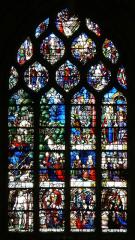
Legend of St. Eustace - Saint-Étienne de Beauvais

Legend of St. Eustace - Saint-Étienne de Beauvais

The stained-glass window illustrating the Legend of St Eustace (baie n° 18) in Saint-Étienne de Beauvais is a composite Renaissance work, produced in successive campaigns between 1553 and c. 1575. Its extended execution reflects a cumulative process of patronage, bringing together multiple donors, artists, and workshops within a single coherent narrative cycle.


Marriage, Annunciation, and Visitation

Marriage, Annunciation, and Visitation

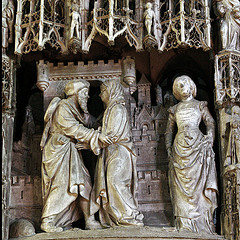
This second sequence of sculpture on the choir screen, starting at the western end of the south ambulatory, is the work of Jehan Soulas from 1520-1535. Sculpted from the hard limestone from the Tonnerre quarry they consist of scenes from the Gospel of James, depicting the marriage of the Virgin Mary to Joseph, the annunciation, and the visitation.

Pages

Subscribe to Saints