
This window by Hardman & Co. illustrates the first of Christ's Miracles.

This window by Hardman & Co. illustrates the first of Christ's Miracles.
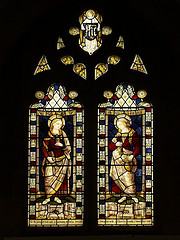
Burlison & Grylls window depicting Mary and Martha Clifton on Dunsmore.
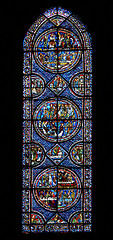
Depicting the events in the life of Mary of Magdalene this window, in Chartres Cathedral, is from about 1210. According to Christian tradition she was one of Jesus' follows in Galilee, healed of seven devils, was present at the crucifixion, was the person to find the tomb empty, and the first person whom Jesus appeared to and given the task of announcing his Resurrection.
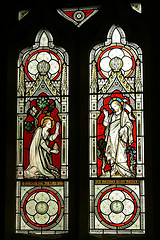
Hardman representation of Jesus appearing to Mary of Magdalene at the tomb (John 20:17).
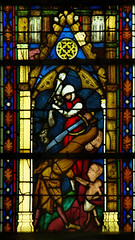
These two stained-glass panels from the choir clerestory of St Ouen form a paired narrative of the Massacre of the Innocents, rendered in the incisive and highly expressive manner characteristic of the early 14th-century Norman workshops. Though each panel stands within its own Gothic architectural frame, complete with gabled canopies, foliate bosses, and alternating bands of strong primary colour, the scenes are conceived as a continuous episode of violent disruption, unfolding across two moments of the same biblical tragedy.

Mauméjean were a family of stained glass designers and manufacturer that were established in South western France, originally in Pau in1860, and later to Biarritz and Madrid.
 St Nicholas parish church in Stanford on Avon, Northamptonshire, contains a large amount of stained glass dating from c1330 - 1540. The early glass contains images of Saints and Bishops, whilst the later glass contains Netherlandish roundels, and images of the Cave family that were the donors.
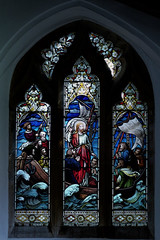
Situated in the east window of the south aisle, of the church of St Peter and St Paul, Maidford, Northamptonshire, this stained-glass memorial commemorates Arthur William Grant, who died on 19 December 1878, aged fifty-five. The window was installed circa 1880, by John Hardman & Co. of Birmingham, whose workshop was among the foremost exponents of the Gothic Revival style.
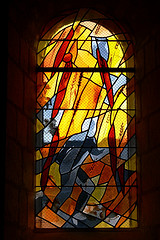
Although biographical information on Catherine Menu remains scarce, her surviving ecclesiastical glass situates her within the post-war renewal of sacred art in France, a movement that sought to reconcile liturgical tradition with the visual language of modernism. Menu appears to have been active from the 1970s through the 1990s, producing windows for parish churches in the Loir-et-Cher and surrounding departments.


