
Pope, Melanie
Melanie Pope is an English glass artist active from the early 1990s onwards.1 She trained in stained glass beginning in 1990, working on new commissions as well as conservation and restoration work in leaded glass. In 1995 she adopted and developed glass fusing and kiln techniques, expanding her practice into a broader exploration of kiln-formed glass alongside traditional stained and painted glass. Her work encompasses both architectural stained glass and decorative glass pieces, and she has been involved in workshops and teaching as part of her practice. Based in the East Midlands, Pope’s work reflects a combination of craft skill, narrative clarity, and technical versatility across stained and kiln-formed media.
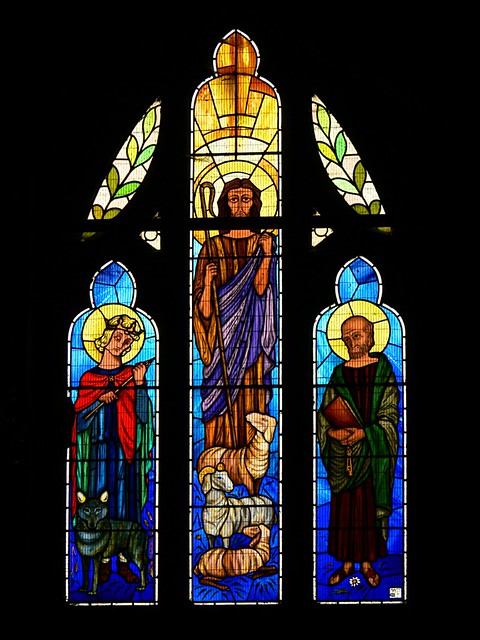
The east window, featured above, presents a modern devotional composition rooted in traditional iconography, with simplified forms and a clear, luminous palette.
Central light:
Christ is shown as the Good Shepherd, standing frontally and haloed, holding a shepherd’s staff with sheep gathered at his feet. The emphasis is on pastoral care, protection, and guidance, appropriate to the theological focus of the east end.
Left-hand light:
The figure represents Saint Edmund ⓘ, identified by the presence of the wolf, recalling the legend in which the saint’s severed head was guarded by a wolf after his martyrdom. The pairing of saint and animal is rendered with clarity and restraint, making the identification immediately legible.
Right-hand light:
A haloed saint stands in quiet contemplation, holding a book and set against a deep blue ground. The simplified pose and strong outline mirror the left-hand light, maintaining balance across the composition.
Tracery and detail:
Abstracted foliage and warm amber glass fill the tracery, while the artist’s monogram and date (1997) appear at the lower right, securely dating the work.
The window exemplifies late twentieth-century ecclesiastical stained glass, combining traditional subject matter with contemporary handling of line and colour. Pope’s approach avoids historical pastiche while remaining fully legible within the language of the parish church, demonstrating the continued vitality of stained glass as a living craft at the close of the century.
