
Index of Renaissance Sculpture
The Apostles in Art: Witness, Memory, and Transformation

The Prato pulpit was commissioned by the Operai del Duomo di Prato for the exterior corner of the cathedral, specifically to display the Sacra Cintola (Holy Belt of the Virgin Mary), Prato’s most treasured relic.

Between 1431 and 1438, the Florentine sculptor Luca della Robbia carved in marble one of the most radiant celebrations of music and childhood in the early Renaissance, the Cantoria, or singing gallery, originally made for the north singing gallery of Florence Cathedral.

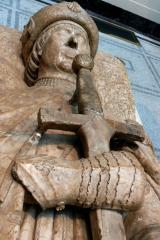
This funerary monument depicts Don García Osorio, a knight of the Order of Santiago, shown in repose with hands crossed upon his sword, a symbol of both chivalric honor and Christian faith. Carved in Toledo (1499-1505), probably by a sculptor influenced by Egas Cueman or Sebastián de Almonacid.
Effigy of Donna Maria de Perea wearing a simple dress and with rosary in her hands.
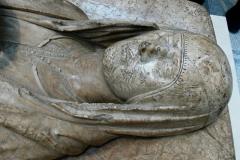
Agnès Sorel (d1450) was the mistress of King Charles VII of France to whom she gave birth to three daughters to Charles VII.
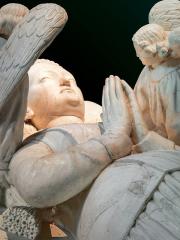
Started in 1515, and completed in 1525, this tomb is the work of the Roullant Le Roux, Rouen cathedral's master mason of the time. It is a memorial to the French cardinal and archbishop of Rouen George d'Amboise (d1510), the other figure is his nephew George d'Amboise (d1550) who became archbishop of Rouen on his uncle's death.

Above the choir screen at Chartres Cathedral are some 40 sculpted reliefs of biblical scenes, and other scenes from the life of the Virgin Mary. The scenes were sculpted by some of the best artists in France and were commissioned at different times over a 200 year period from 1510 to 1720.
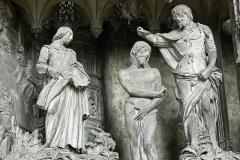
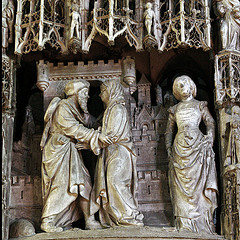
The first sequence of sculpture around the choir screen, starting at the western end of the south ambulatory, is the work of Jehan Soulas from 1519-1521. Sculpted from the hard limestone from the Tonnerre quarry, they consist of scenes from the Gospel of James, depicting the annunciation of the Virgin Mary to Joachim and St Anne, the birth of Mary, and the presentation of Mary in the temple.
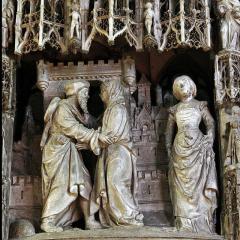
This second sequence of sculpture on the choir screen, starting at the western end of the south ambulatory, is the work of Jehan Soulas from 1520-1535. Sculpted from the hard limestone from the Tonnerre quarry they consist of scenes from the Gospel of James, depicting the marriage of the Virgin Mary to Joseph, the annunciation, and the visitation.
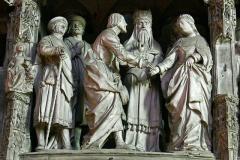

This third sequence of sculpture on the choir screen, starting at the western end of the south ambulatory, is the work of Jehan Soulas from 1521-1535. Sculpted from the hard limestone from the Tonnerre quarry, this consist of scenes depicting the Nativity, Circumcision, and Epiphany.
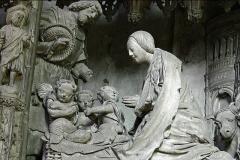
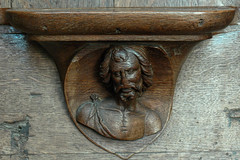 The choir stalls of the collegiate church of Saint-Jean-Baptiste at Montrésor form one of the most eloquent ensembles of Renaissance woodcarving in Touraine. They were made around 1530-1540, when Imbert de Batarnay, seigneur of Montrésor and counsellor to four French kings, endowed the new collegiate foundation he had created in 1521.
This monument to Louis de Brézé (d1531) is the work of Jean Goujon (1510-1572) who was commissioned by Diane de Poitiers, Louis wife. Louis was the son of King Charles VII of France's illegitimate daughter Charlotte de France.
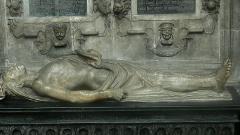
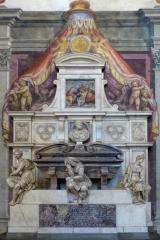
This tomb dedicated to Michelangelo was created by Vasari in 1570 and contains elements of Sculpture, Architecture and Painting.
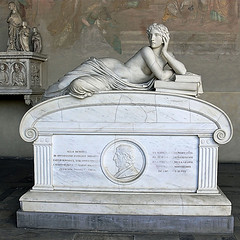
Allegorical figure of Science on the tomb of the physicist Ottaviano Fabrizio Mossott (d1863) in the Camposanto Monumentale, Pisa, by the sculptor Giovanni Duprè.