
Legend of St. Eustace - Saint-Étienne de Beauvais
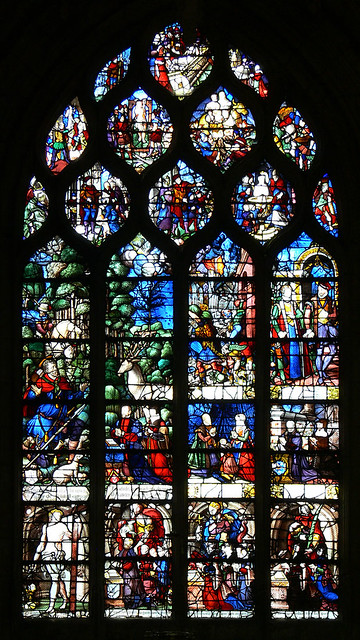
The stained-glass window illustrating the Legend of St Eustace (baie n° 18) in Saint-Étienne ⓘ de Beauvais is a composite Renaissance work, produced in successive campaigns between 1553 and c. 1575. Its extended execution reflects a cumulative process of patronage, bringing together multiple donors, artists, and workshops within a single coherent narrative cycle.
Early campaign (1553)
In 1553, the merchant-draper Jean de Malinguehen, a former mayor of Beauvais, donated the lower register panels. These depict Jean de Malinguehen and his family as kneeling donors, presented before Christ administering the Eucharist. This phase represents the earliest securely dated contribution to the window and establishes the devotional framework of the programme.
Second campaign (1554): the Vision of St Eustace

The second stage of glazing, dated 1554, comprises the central scene of the Vision of St Eustace, in which the saint encounters the stag bearing the crucifix. In this principal panel, St Eustace and his wife are accompanied by donor portraits of the merchant-draper Eustache de la Croix and his wife Françoise de Nully, shown kneeling in prayer.
This central scene is attributed to Nicolas Le Prince, on the basis of stylistic analysis and his documented activity in Beauvais during the mid-16th century. The attribution was notably advanced by Jean Lafond in 1929, drawing attention to affinities in figure modelling, landscape treatment, and compositional clarity, as well as to a 1558 contract for a bas-relief by the same artist.
The 1554 panels display characteristics associated with the Le Prince workshop, whose members played a central role in the development of Renaissance stained glass in Beauvais, particularly in their use of luminous glass, balanced compositions, and refined spatial depth.
Later completion (1572–1575)
A further phase of work followed nearly two decades later. On 13 May 1572, a contract was signed between the master glazier Romain Buron, a native of Gisors and a disciple of Engrand Le Prince, and the Beauvais merchant Nicolas Brocard. This agreement concerned the completion of two historiated windows in the church, including additional episodes from the Life of St Eustace, such as plague, the death of livestock, pillaging, and forced flight.
The donor panels from this campaign depict Mahiot Brocard (d. 19 April 1572) and his wife Huguette de Bray. Work appears to have continued until around 1575, when the newly commissioned scenes were integrated into the median and upper registers of the window.
Organisation and style
The prolonged execution of the window suggests coordination—possibly under the auspices of the Confrérie de Saint-Eustache ⓘ—which helped unify multiple donations into a coherent narrative programme.
Stylistically, the later glazing attributed to Romain Buron is distinguished by heavier enamels and denser colour modelling, producing a more opaque effect than the earlier Le Prince-influenced panels. While technically competent and narratively clear, this later work has generally been regarded by historians as less brilliant than some other 16th-century stained glass produced in Beauvais.
