
Saint Andrew the Apostle
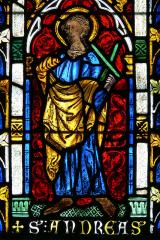
Andrew was a Galilean fisherman, the son of Jona (Jonah) and brother of Simon Peter. Originally a disciple of John the Baptist ⓘ, he was among the first to encounter Jesus and is traditionally regarded as Christ’s first disciple. Andrew then brought his brother Simon to Jesus, playing a quiet but pivotal role in the calling of the Apostles.
Andrew appears several times in the Gospels, often as an intermediary figure. It is Andrew who introduces to Jesus the boy carrying the loaves and fishes at Bethsaida, an episode that underscores his recurring role as one who brings others into Christ’s presence.
According to early Christian tradition, Andrew was martyred at Patrae in Achaia, where he was crucified while bound, rather than nailed, to the cross. From the 14th century onward, a tradition developed that his cross was X-shaped, reflecting the belief that—like his brother Peter—Andrew considered himself unworthy to be crucified on the same upright cross as Christ.
Saint Andrew in Art
St Andrew appears in Christian art from the early Middle Ages onward, most often identified by the saltire, or X-shaped cross, on which he was believed to have been martyred. This distinctive attribute made Andrew immediately recognisable and ensured his prominence in both narrative cycles and independent devotional images.
In medieval art, Andrew frequently appears among the Twelve Apostles, in Last Supper scenes, and in apostolic series, where he is typically shown as an elderly, bearded figure holding either a book or his cross. From the later Middle Ages, scenes of his martyrdom become more common, depicting him bound rather than nailed to the cross, in accordance with hagiographic tradition that emphasised his humility and willingness to suffer.
Andrew’s cult developed strongly in both the Latin West and the Byzantine world. In Western Europe, his imagery was often associated with ideas of apostolic mission and sacrifice, while in Scotland—where he became the national patron saint—the saltire acquired powerful political and symbolic meaning. In Eastern Christian art, Andrew is likewise represented as a foundational apostle, often emphasised as the “first-called” disciple.
Across media—sculpture, stained glass, wall painting, and panel painting—St Andrew’s ⓘ iconography balances narrative depictions of his calling and martyrdom with iconic representations that stress his authority as an apostle and his role as a model of faith and endurance.