
Charlemagne
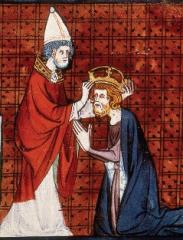
Charlemagne, also known as Charles the Great, was King of the Franks from 768 and Emperor from 800 until his death in 814. His reign transformed the political landscape of western Europe and laid the foundations for the later Holy Roman Empire.
The son of Pippin III, Charlemagne inherited the Frankish kingdom jointly with his brother Carloman. After Carloman’s death in 771 he became sole ruler. Over the following decades he expanded his authority through sustained military campaigns against the Lombards, Saxons, Avars and others, extending Frankish influence across much of western and central Europe.
In 774 he assumed the title King of the Lombards. His prolonged campaigns in Saxony combined conquest with forced conversion, integrating the region into the Frankish realm. Administrative reform, capitular legislation, and the development of a network of counts and missi dominici strengthened royal governance.
On 25 December 800, in Rome, he was crowned Emperor of the Romans by Pope Leo III ⓘ. The coronation expressed a renewed claim to imperial authority in the Latin West and reshaped the relationship between monarchy and papacy. Whether Charlemagne anticipated the act remains debated, but the imperial title enhanced his prestige and reinforced the universal ambitions of his rule.
Charlemagne also presided over a cultural revival often termed the Carolingian Renaissance. Under the influence of scholars such as Alcuin of York, scriptoria, schools and liturgical reform flourished. Standardisation of script and texts had lasting consequences for the transmission of classical and Christian learning.
He died in 814 and was buried at Aachen. His empire did not long remain unified, yet his reign became a central reference point for medieval kingship and imperial ideology.