Nicholson, A. K.
A. K. Nicholson (Alexander Kenneth Nicholson) was an English stained-glass artist active in the first half of the twentieth century. Working during a period that bridged late Victorian traditions and the interwar revival of ecclesiastical art, Nicholson developed a style marked by clarity of line, luminous colour, and balanced figural composition.
His work often retains Gothic architectural framing while simplifying modelling and emphasising strong contour drawing. Compared with the denser academicism of nineteenth-century studios, Nicholson’s glass exhibits a cleaner, more modern graphic sensibility, particularly evident in his 1930s commissions.
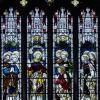
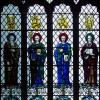
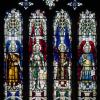
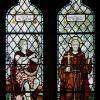
Nicholson executed windows for parish churches across England, frequently focusing on angelic hierarchies, saints, and biblical narrative subjects. His figures are typically elongated yet restrained, and his colour schemes favour saturated blues, reds, and golds set against lighter quarry backgrounds.
He stands within the continuation of English ecclesiastical stained glass into the twentieth century, maintaining traditional iconography while adapting it to a more streamlined aesthetic.
After his death, the workshop continued as A. K. Nicholson Studios, directed first by his chief designer G. E. R. Smith ⓘ (1883–1959), who had joined the firm in 1906. The studio remained active into the 1960s, later under Hew and Margaret Pawle.