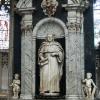
Green, Thomas of Camberwell
Thomas Green (died c. 1730) was a leading English sculptor and statuary active in the late seventeenth and early eighteenth centuries. According to Gunnis, he ranks among the outstanding sculptors of the first part of the eighteenth century, with a career encompassing ecclesiastical monuments, architectural statuary, and extensive official and armorial work.
Green entered the profession through a traditional apprenticeship, being bound to John Fitch in 1673. He subsequently worked under William Hind, and by 1694 is recorded as a journeyman to Thomas Artwright the Elder, placing him firmly within the principal London tradition of professional statuary. This progression reflects a thorough grounding in both figurative sculpture and architectural carving.
His output was not confined to church monuments. Green undertook a substantial volume of armorial and decorative sculpture for barracks and government buildings, notably in and around Chatham, reflecting the expanding demands of the late Stuart and early Georgian state for symbolic and institutional sculpture. Such work situates him among the sculptors contributing to the visual identity of military and governmental authority in the period.
Stylistically, Green’s work occupies a transitional position between late Stuart Baroque traditions and the more ordered, classical tendencies that would characterise early Georgian sculpture. His figures combine structural clarity with controlled ornament, favouring dignity and permanence over dramatic effect. Through both his monuments and official commissions, Green played a significant role in shaping English statuary in the decades preceding academic neoclassicism.