
Philip II of France
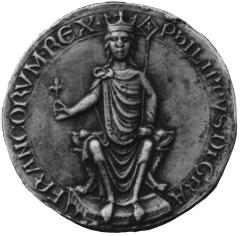
Philip II of France, known as Philip Augustus, was king of France from 1180 to 1223. His reign marked a decisive expansion of Capetian authority and a fundamental restructuring of political power in western France.
When Philip came to the throne, much of the territory that now forms France was controlled by powerful princes, most notably the Angevin kings of England, Henry II of England ⓘ, Richard I ⓘ, and John ⓘ. Through warfare, legal challenge, and diplomatic pressure, Philip systematically reduced Angevin holdings on the Continent.
In 1202 he declared John’s continental fiefs forfeit. The subsequent conquest of Normandy (1204), followed by the absorption of Anjou and other territories, permanently altered the balance between the French and English crowns. For the first time, the Capetian monarchy controlled the core territories of northern France directly.
The turning point of his reign came at the Battle of Bouvines in 1214, where Philip defeated a coalition including imperial and Flemish forces allied with England. The victory confirmed French territorial gains and weakened John’s position in England, contributing indirectly to the crisis that produced Magna Carta in 1215.
Philip’s achievement was not only military. He strengthened royal administration by expanding the role of baillis and prévôts, extending royal justice, and consolidating fiscal oversight. These measures increased the crown’s presence in the provinces and reduced reliance on intermediary lords.
Paris benefited visibly from his rule. Philip fortified the city, reorganised its commercial infrastructure, and supported institutions that contributed to the development of the University of Paris, reinforcing the capital’s political and intellectual importance.
Philip also participated in the Third Crusade (1190–1191) alongside Richard I ⓘ. Although he returned to France before the campaign concluded, his participation affirmed his standing within Latin Christendom while allowing him to consolidate gains in Europe.
By the time of his death in 1223, the Capetian monarchy had been transformed from a relatively modest royal domain into a territorially coherent and administratively strengthened kingdom. His reign laid the structural foundations upon which his successors, including Louis VIII of France ⓘ and Louis IX of France, would build.
Succession
Preceded by: Louis VII of France ; Succeeded by: Louis VIII of France