
Saint Teresa of Ávila - Orleans Cathedral
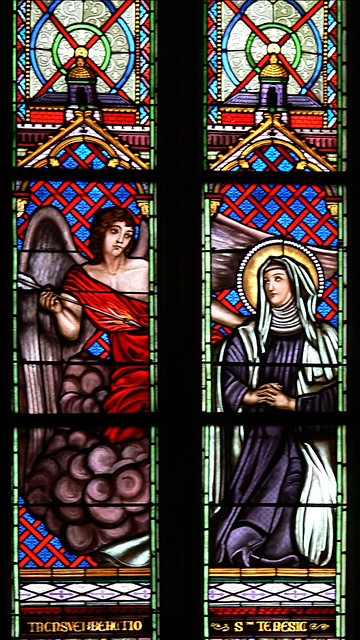
These three stained-glass panels depicting Saint Teresa of Ávila form part of the nineteenth-century glazing of Orléans Cathedral and are the work of the French stained-glass painter Lucien Lobin. Executed in a rich, academic style, the panels combine vivid colour, strong lead-line drawing, and carefully modelled figures set against patterned grounds characteristic of Lobin’s mature work.
Teresa of Ávila (1515–1582) was a Spanish Carmelite nun, mystic, and one of the most influential spiritual figures of the Catholic Counter-Reformation. Alongside the mystic Saint John ⓘ of the Cross, she is regarded as the founder of the reformed Carmelite branch known as the Discalced, or “Barefoot,” Carmelites. In the upper panel she appears in dialogue with John of the Cross, visually affirming their shared role in the Carmelite reform and their spiritual partnership.

After entering religious life, Teresa endured a prolonged and debilitating illness, often identified in modern scholarship as a form of malaria, which left her partially paralysed for a time. During this period she began to experience intense mystical visions and auditory phenomena, which she understood as communications from God. These experiences aroused suspicion among some contemporaries, who dismissed her as deluded or feared demonic influence. Despite this opposition, her visions continued and became central to her spiritual identity, including the celebrated transverberation: a vision of a seraph piercing her heart with a golden arrow, symbolising divine love. This episode, one of the most famous in Christian mystical literature, is alluded to in the iconography of the series.

Teresa emerged not only as a visionary but also as a determined reformer. Disturbed by the lax discipline she encountered in many Spanish convents, she established a network of reformed Carmelite houses committed to poverty, enclosure, and contemplative prayer. Travelling widely across Spain, and briefly into Portugal, she founded sixteen convents, often in the face of strong institutional resistance.
In 1582, while travelling from Burgos to Alba de Tormes, Teresa fell gravely ill. She arrived exhausted at the convent there, took to her bed, and never recovered, dying on 4 October 1582. Lobin’s panels at Orléans present her not simply as a mystic saint, but as a figure of intellectual authority, spiritual courage, and reforming zeal, qualities that secured her later recognition as a Doctor of the Church and ensured her enduring place in Carmelite and Catholic history.
