
This small, plain circular font stands on a simple pedestal at All Saints’ Church, Brixworth. Earlier antiquaries proposed a Roman date, owing to the church’s proximity to known Roman remains and the bowl’s unadorned form. Modern scholarship, however, has set aside this attribution: the proportions, tooling, and contextual evidence align more convincingly with a late Saxon origin.
Baptismal-Fonts-and-Stoups Theme Pages
The font is where a child or adult is baptised into the church. The ceremony involves immersing, washing, or pouring water over the head of the person being baptised.
A stoup is a similar type of receptacle for water that has been blessed by the priest. These are placed at the entrance of a church for adherents to use in order to make th sign of the cross.


This substantial Norman font consists of a deep, cylindrical bowl carved from a single block of pale limestone, its massive wall thickness characteristic of 11th–12th-century English baptismal vessels intended to hold a significant volume of water. The exterior remains undecorated except for toolmarks and age-related fissures, consistent with the plain, functional aesthetic of early Romanesque fonts in the region.

This is a Norman cylindrical tub font, carved from a single block of limestone and left entirely plain. Unlike the very large monumental tubs found elsewhere in Northamptonshire and the Midlands, the Ashby St Ledger example is more modest in diameter and height, reflecting the considerable variation in scale among 11th–12th-century rural fonts.

This panel forms part of the Norman font at Aston le Walls and displays a vigorously carved Tree of Life design, executed in shallow but bold relief. The carving is divided by vertical ribs into compartments, each containing a stylised vegetal motif characteristic of early Romanesque ornament.

Early 12th century red sandstone font at Ryton-on-Dunsmore, Warwickshire.
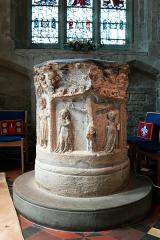
This remarkable Romanesque font at Burford is one of the finest surviving sculpted examples in Oxfordshire. Carved from a single massive block of limestone, the bowl is cylindrical in form and ornamented with a sequence of high-relief narrative scenes, though many are now heavily eroded. Despite the loss of surface detail, the surviving compositions still convey the ambition of the original programme.

This remarkably plain tub-shaped font is carved from a single block of limestone and stands on a broad, roughly moulded base. The bowl has a simple tapering profile, flaring slightly towards the rim before narrowing to meet the foot. No mouldings, arcading, or decorative tooling survive, and the surface shows heavy wear and abrasion.

This Romanesque font consists of a square limestone bowl carved with a beaded top border and a continuous frieze depicting four scenes from the life of Christ. The sculptor employed bold, shallow relief, characteristic of mid-12th-century work in the Northamptonshire region, with large-eyed figures, simplified drapery, and compressed narrative groupings.
The four scenes, arranged one per face of the bowl, are:
-
The Nativity – The infant Christ with attendant figures, typically Mary reclining or seated and the midwives, rendered in a compact composition.
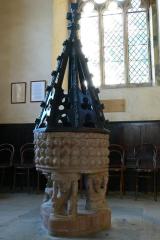
This distinctive Romanesque font at the church of St Margaret of Antioch, Crick is one of the most characterful 12th-century fonts in Northamptonshire. The cylindrical sandstone bowl is decorated with a dense field of large, hemispherical beads arranged in horizontal rows—a bold, tactile ornament strongly associated with mid-12th-century sculptural practice in the central Midlands.

This unusual 12th-century font in the Basilica of Our Lady of Orcival is carved from local volcanic stone and forms part of a long tradition of sacred water use at the site. The basilica itself stands above the remains of a 6th-century church, which in turn was constructed over a natural spring associated with pre-Christian ritual activity in the region. The medieval builders incorporated the flowing water deliberately into the new Romanesque liturgical arrangement, transforming an older sacred source into a Christian baptismal structure.

This substantial Norman font at St Mary’s, Dodford, is carved from a single block of limestone and decorated with an unusually rich frieze of beaded lunettes, each containing a stylised foliate motif. The lunettes, semi-circular arches with a prominent bead moulding along the inner rim, form a continuous band around the bowl, giving the font a strongly architectural, arcade-like rhythm.

This imposing Norman font at Hereford Cathedral is a mid-12th-century work of exceptional scale and ambition. Carved from a single massive block of limestone, the bowl is large enough to have allowed for the immersion of infants, reflecting early medieval baptismal practice.

This mid C12 Norman font at Churchover in Warwickshire, is shaped as a truncated cone, with a cable ornamentation around the top.

This unusual Romanesque font consists of a heavy, marble bowl carved with large, stylised leaf motifs rising from the base of each face. The carving—broad, deeply incised, and rhythmically symmetrical—is characteristic of 12th-century vegetal ornament, combining elements of the acanthus and palmette in a strongly schematic Romanesque manner.

This Romanesque stoup from Meusnes represents the enduring medieval tradition of carved stone bénitiers in rural churches. Its monumental simplicity and durable craftsmanship connect it to the earliest phases of ecclesiastical stone carving in the region, standing in marked contrast to the decorative Renaissance and neo-Gothic fonts of later centuries.

A large, plain polygonal limestone font comprising a deep, thick-walled basin carved from a single block and set on a roughly built cylindrical stem of coursed rubble masonry, rising from a simple square plinth. The basin’s heavy proportions, undecorated exterior, and slightly irregular polygonal plan are characteristic of late Romanesque rural production in the Berry–Touraine region.

This robust Romanesque holy water stoup carved from a single block of local limestone. The stoup consists of a cylindrical shaft with slightly chamfered edges, surmounted by a broad, octagonal basin with a pronounced, tapering undercut. The form is functional, devoid of ornamentation, and characterized by thick proportions that suggest early medieval workmanship.

This late 12th-century font at St Nicholas, South Kilworth, is carved in the form of a large inverted capital, a type found in several East Midlands Romanesque churches. The bowl flares outward from a cylindrical stem, its surface treated with a series of broad, vertical flutes rising into stylised leaf motifs at the rim.

The plain, undecorated circular font, dating from the 13th century, can be found in the church of St Michael, Warmington, Warwickshire.

This 13th-century font at St Giles, Chesterton, is a plain circular bowl that tapers slightly towards the base, typical of the restrained Gothic forms that replaced the richer Romanesque carving of the previous century. The bowl has a simple moulded top rim and a broad chamfered lower edge, giving the vessel a clean, architectural profile without decorative foliage or figure work.