Life of Saint Taurin 3

15th century stained glass depicting events in the life of St Taurin and the discovery of his relics by St Landulfe.
15th century stained glass depicting events in the life of St Taurin and the discovery of his relics by St Landulfe.
This tall lancet window (c. 1300) os one of two windows that presents a compact cycle of the Life of St Martin ⓘ, arranged in five horizontal registers, each split into two quatrefoil ⓘ medallions. The sequence highlights Martin’s charity, his spiritual trials, his episcopal authority, and his miraculous power as missionary and bishop. The glass is characteristic of the early 14th century at Tours, with intense blues and reds, crisp linear painting, and lively narrative detail.
Sequence of 13th century wall painting from the in the nave of St. Albans Cathedral show scenes from the life of the Virgin Mary ⓘ.
 Lord John Cheney (d1499) was a Lancastrian supporter who in 1483 had supported the Duke of Buckingham's rebellion against Richard III. When Buckingham's rebellion failed he joined Henry Tudor in Brittany and returned with him from France in 1485.
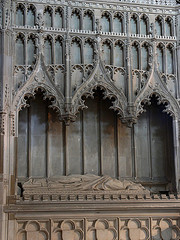
Louis of Luxemboug (d1443). Brother of the governor of Paris who sold Joan of Arc to the English.
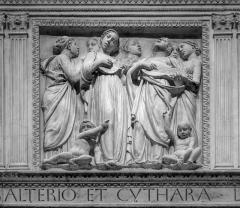
Between 1431 and 1438, the Florentine sculptor Luca della Robbia ⓘ carved in marble one of the most radiant celebrations of music and childhood in the early Renaissance, the Cantoria, or singing gallery, originally made for the north singing gallery of Florence Cathedral.
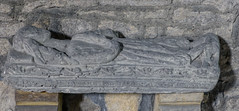 The Tomb of Mabilia de Murdak (also spelled Mabilla or Mabila) is a small 14th-century medieval monument. The tomb is part of a collection of stone memorials in the north chapel (or Gayton Chapel), which includes effigies of local nobility tied to dramatic family events, such as murder and pilgrimage.
This window in the North transept of Great Malvern Priory was a gift from Henry VII in 1501. Containing scenes from the life of the Virgin Mary ⓘ and the life of Christ., it is known as the Magnificat window because it contains the Song of Mary from Luke 1:46-55.

The Marmousets Portal Tympanum ⓘ is a late Gothic sculpture adorning the Porche des Marmousets (Portal of the Marmousets) is the main pedestrian entrance to the Abbey Church of Saint-Ouen in Rouen, Normandy, France. This Flamboyant Gothic portal, primarily honors the Virgin Mary ⓘ, dates to around 1430 and was crafted by the master sculptor Alexandre de Berneval, and is located at the south transept.

The south porch of Chartres Cathedral contains a series of sculptures, that were made between 1194 and 1230, on the subject of the martyrdom of saints.