Mary Magdalene at the Tomb - Ladbroke, Warwickshire
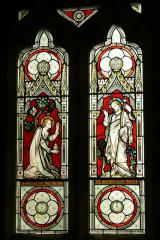
Hardman representation of Jesus appearing to Mary of Magdalene ⓘ at the tomb (John 20:17).
Hardman representation of Jesus appearing to Mary of Magdalene ⓘ at the tomb (John 20:17).
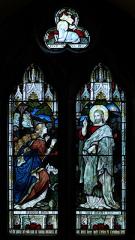
This two-light stained-glass window, dated 1893 and signed by Jones & Willis, is located in the church at Tiffield. It depicts the meeting of Mary Magdalene ⓘ and the risen Christ in the garden, the Noli me tangere episode described in the Gospel of St John ⓘ.
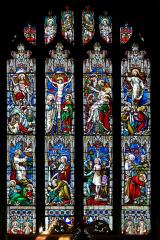
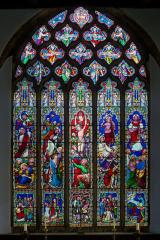
This east window, dated 1866 and designed by William Wailes, is devoted to the Crucifixion and the principal episodes of Christ’s Passion. It exemplifies the mature Victorian narrative window, combining theological clarity with strong colour and carefully ordered figural sequences.
This two-light window, executed by Kempe & Tower in 1921, depicts the Presentation of Christ in the Temple, a subject long favoured by the firm for its devotional clarity and balanced figural grouping.
Left-hand light:
The Virgin Mary ⓘ is shown kneeling in prayerful humility, her posture inward and composed. Behind her, attendant figures are arranged beneath an architectural canopy, reinforcing the Temple setting and providing depth without distracting from the principal action.
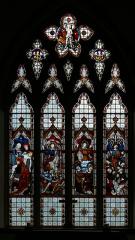
This four light window by Clayton and Bell, can be found at St Michael's church Warmington, Warwickshire. The four scenes show the descent from the cross; the Resurrection; the Ascension; and the Descent of the holy spirit. In the tracery St Michael is shown defeating the dragon.
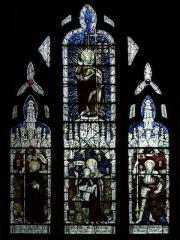
A richly coloured memorial window by Charles Eamer Kempe fills the east wall of the south chapel.
Centre light: The Risen Christ, crowned and bearing the banner of the Resurrection, stands in triumph. Below, St Anne with the Virgin emphasises lineage and devotion, anchoring the Resurrection theme in holy kinship.
Left-hand light: St Thomas ⓘ, holding a spear, identified by his traditional attribute.
Right-hand light: St George, the soldier-saint, likewise armed, balancing the composition with martial sanctity.
This multi-light stained glass window, dated 1863 and designed by William Wailes, presents a richly structured typological meditation on sacrifice, suffering, and redemption, characteristic of mid-Victorian Anglican theology and narrative glass.
The principal upper sequence depicts the central events of Christ’s Passion and glorification:
The Agony in the Garden
Christ carrying the Cross
The Crucifixion, occupying the dominant central position
The Resurrection
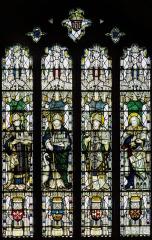
This four-light window, at All Saints Stamford, dated 1897, was executed by C. E. Kempe & Co. and presents the patron saints of four major English cathedrals: Lincoln, Peterborough, Lichfield, and York.
Each saint stands beneath elaborate architectural canopies, with heraldic devices displayed below and cathedral associations indicated by inscriptions.
From left to right:
St Hugh of Lincoln, bishop and reformer of the twelfth century, holding crozier and book.
St Peter ⓘ (Peterborough Cathedral), bearing keys and pastoral insignia.
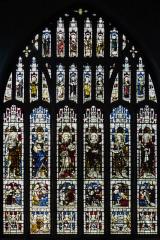
This monumental six-light west window, installed in 1888, was executed by Clayton & Bell ⓘ and commissioned by Edward Ingersoll Browne of Boston, Massachusetts, in memory of Charles Browne, descendant of the fifteenth-century Browne family of Stamford. It consciously recalls the Browne family’s late medieval patronage of the church.
The programme follows a hierarchical structure consistent with the hymn Te Deum laudamus, uniting angels, prophets, saints, and narrative scenes in a vertical theological progression.
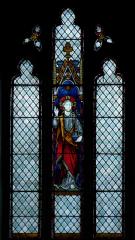
The east window of 1875, made by John Hardman & Co., stands in the church at Maidford. The central light depicts Christ as Salvator Mundi, set within flanking lights of patterned diamond quarries.