16th century
Black Madonna - Chartres Cathedral
This image shows the Virgin and Child of Chartres Cathedral, commonly known as the Black Madonna of Chartres (Notre-Dame du Pilier). It is one of the most venerated Marian sculptures in France and a central focus of devotion within the cathedral. It was commissioned in 1508 as a black wooden copy of the 13th century silver Madonna that stood on the main altar at Chartres Cathedral.
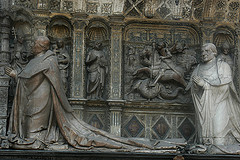
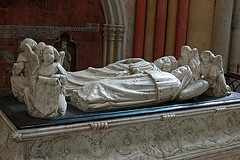
Cardinals of Amboise Tomb - Rouen Cathedral
Started in 1515, and completed in 1525, this tomb is the work of the Roullant Le Roux, Rouen cathedral's master mason of the time. It is a memorial to the French cardinal and archbishop of Rouen George d'Amboise (d1510), the other figure is his nephew George d'Amboise (d1550) who became archbishop of Rouen on his uncle's death.
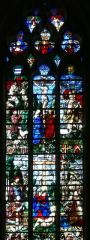
Chapel of the Sacred Heart - Beauvais Cathedral
The Sacred Heart Chapel in Beauvais Cathedral contains this stained glass window by Engrand Le Prince. It was commissioned in 1522 by Louis de Roncherolles chamberlain and councillor to Francis I of France.
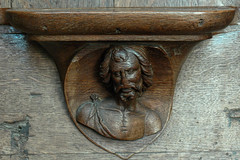
Choir stalls Saint-Jean-Baptiste at Montrésor - France
The choir stalls of the collegiate church of Saint-Jean ⓘ-Baptiste at Montrésor form one of the most eloquent ensembles of Renaissance woodcarving in Touraine. They were made around 1530-1540, when Imbert de Batarnay, seigneur of Montrésor and counsellor to four French kings, endowed the new collegiate foundation he had created in 1521.
Cleansing the Temple Polychrome Relief - Amiens Cathedral
This richly animated cycle of polychrome reliefs depicts the episode of Christ Cleansing the Temple (Matthew 21:12–13; Mark 11:15–17; Luke 19:45–46; John 2:13–16). Carved in deep relief and originally conceived as a continuous narrative sequence, the scenes unfold across the west wall of the north transept, drawing the viewer into the crowded precincts of the Temple in Jerusalem.
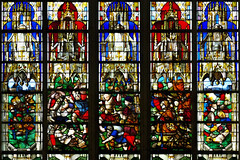
Composite Window - Stoning of St Stephen and Martyrdom of St Catherine
This window is a composite assembly combining fragments of sixteenth-century stained glass with nineteenth-century architectural structures and extensive twentieth-century restoration. The present arrangement consists of five tall lancets surmounted by a unified canopy system reconstructed in 1852, with bases and pedestals also installed at that time.