14th century
14th-century brasses
14th-century brasses (c. 1300–1400) emerge as a distinctive and increasingly popular form of commemoration in English churches. Engraved figures of knights, clergy, and merchants combine heraldry, costume, and devotional imagery, expressing social identity, piety, and the hope of salvation through prayer and remembrance.
14th-century tombs
14th-century tombs (c. 1300–1400) develop the effigial tradition with greater realism and ornament. Recumbent figures in stone or alabaster display detailed armour and dress, reflecting chivalric ideals, social hierarchy, and a growing concern with death, memory, and intercessory prayer.
Bishop Thomas de Cobham Effigy - Worcester Cathedral
Purbeck marble ⓘ effigy of Bishop Thomas de Cobham (d1327). Worcester Cathedral.
Brass monument makers, London ‘C’
The designation “London ‘C’” is used by modern scholarship to identify an anonymous group of London-based brass engravers responsible for a coherent body of late medieval monumental brasses. The label derives from stylistic analysis rather than documentary evidence and distinguishes this workshop from other contemporary London groups.
Brunelleschi, Filippo
Filippo Brunelleschi stands at the threshold of the Renaissance. Trained initially as a goldsmith, he became the architect who transformed the visual language of 15th-century Florence. His work reintroduced the structural clarity, proportional harmony, and classical vocabulary of ancient Rome, while his experiments in linear perspective reshaped pictorial space for generations of artists.
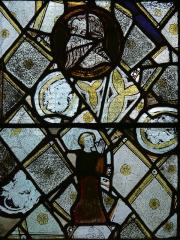
C14 stained glass fragments - Old Arley, Warwickshire
Early C14 fragments of stained glass re-set into north chancel window. St. Wilfred, Old Arley, Warwickshire
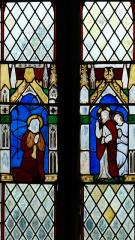
C14th English stained glass fragments - Pattishall Northamptonshire
This fragmentary but evocative window from Holy Cross Church, Pattishall, preserves elements of a 14th-century English stained glass narrative cycle. The surviving lights depict a kneeling orant figure with hands raised in prayer, and beside it, a group showing Christ with a disciple or saint, set beneath delicately painted Gothic architectural canopies.
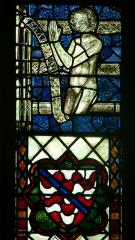
Chancel Windows - Tewkesbury Abbey
The stained glass windows in the chancel of Tewkesbury Abbey are all from between 1338 and 1340. They were most probably a gift to the Abbey by Eleanor Despenser (nee de Clare) the wife of Hugh Despenser the Younger. Eleanor is thought to be the person depicted in the panel here.
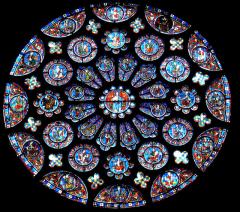
Chartres Cathedral
Chartres Cathedral has some of the most beautiful medieval stained glass windows to have survive the upheavals of the last 800 years. The earliest date from the mid 12th century, but most are from the 13th century.