
Apostles - Kings Sutton, Northamptonshire
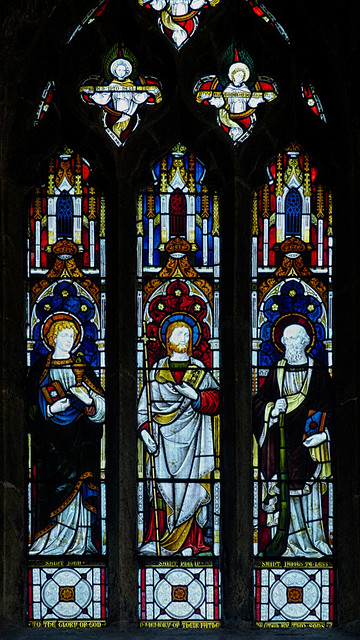
This three-light stained glass window, dated 1869 and made by Burlison & Grylls ⓘ, depicts St John ⓘ, St Philip ⓘ, and St James the Less ⓘ, presented as standing apostles beneath an angelic tracery bearing texts from the Apostles’ Creed. The window forms part of the coherent Victorian apostolic programme at Kings Sutton, combining doctrinal clarity with restrained Gothic revival design.
Main lights (the Apostles)
Each saint is shown full-length, identified by traditional attributes and accompanied by a book signifying apostolic authority and teaching.
-
Left-hand light: St John, holding a chalice and a book. The chalice recalls the legend of the poisoned cup, from which John emerged unharmed, while the book alludes to his authorship of the Gospel and the Apocalypse.
-
Centre light: St Philip, carrying a cross-topped staff and a book. The cross-staff reflects his apostolic mission and martyrdom, while the book again denotes his role as preacher and witness to Christ.
-
Right-hand light: St James the Less, holding a cudgel and a book. The cudgel refers to his martyrdom, traditionally said to have been beaten to death, and serves as his principal identifying emblem.
The figures are rendered with calm dignity, their poses restrained and frontal, in keeping with Burlison & Grylls’s emphasis on legibility, balance, and devotional sobriety.
Tracery and creed texts
In the upper tracery, angels bear inscriptions drawn from the Apostles’ Creed:
-
“He descended into Hell”
-
“He ascended into Heaven” (the latter shown reversed)
These phrases frame the apostolic witnesses within the core statements of Christian belief, linking the testimony of the saints below with the central narrative of Christ’s death, descent, resurrection, and exaltation.
Interpretation and style
The window exemplifies Burlison & Grylls’s mid-Victorian style, characterised by clear outlines, strong colour contrasts, and a disciplined Gothic vocabulary. Rather than dramatic gesture, the emphasis lies on theological identity and continuity: the apostles stand as enduring witnesses to the Creed proclaimed above them.
By combining apostolic figures with creed texts in the tracery, the design reinforces the idea that Christian doctrine is grounded in apostolic testimony, transmitted through teaching and martyrdom alike. The window thus operates both as a devotional image and as a visual statement of Anglican doctrinal inheritance.
