
Elizabeth Darnell - Thrapston, Northamptonshire
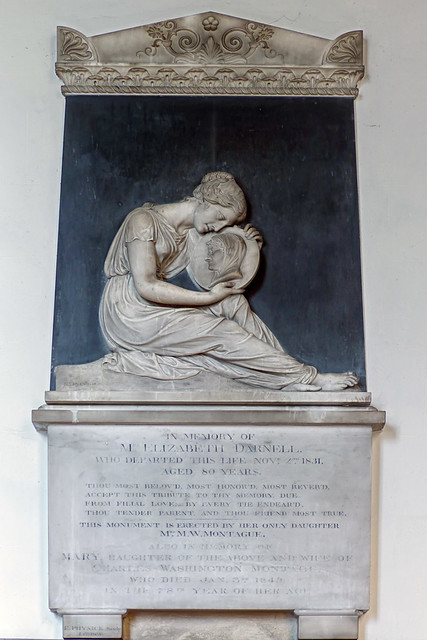
This wall monument, dated 1831, commemorates Elizabeth Darnell and is located at Thrapston, Northamptonshire. It was commissioned by her daughter, Mary Montague, and is signed by the sculptor Edward Physick ⓘ (1810–1842), whose short career produced a small but refined body of funerary work.
The monument is conceived as a deeply recessed relief panel, within which a female mourner is shown seated on the ground, her body folded inward in an attitude of quiet sorrow. Rather than holding a funerary urn, she embraces a round memorial plaque containing a portrait of her mother, transforming the composition from an abstract allegory of death into an intimate act of remembrance.
The figure bends tenderly over the portrait medallion, her head inclined and her arms drawn closely around it, creating a closed and contemplative composition. The circular form of the plaque echoes classical portrait medallions, reinforcing the association with personal memory rather than symbolic substitution. The soft modelling of the drapery and the subdued pose convey restrained grief and emotional inwardness.
Above, the monument is framed by a simple architectural surround, surmounted by a shallow classical pediment enriched with restrained scroll ornament. Below, the inscribed tablet records Elizabeth Darnell’s death in November 1831, aged eighty years, and explicitly notes the filial dedication of the memorial, emphasising the personal motivation behind its commission.
Stylistically, the monument belongs to the late Neoclassical tradition of English funerary sculpture, but with a significant shift away from conventional symbolism. By replacing the urn with a portrait medallion, Physick grounds the memorial in lived relationship and familial memory, aligning the work with early nineteenth-century tendencies toward psychological realism and domestic sentiment.
As a signed work by Edward Physick, the monument is of particular interest, illustrating both the persistence of neoclassical form and its adaptation to more intimate modes of commemoration in the early nineteenth century. It stands as a carefully controlled expression of filial grief and a sensitive example of personal memorial sculpture of the period.
