
Frederick Bagshaw - Thrapston, Northamptonshire
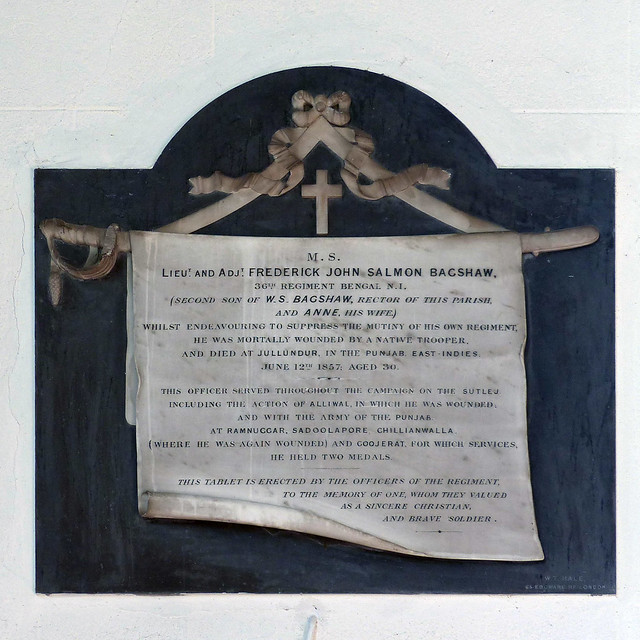
This wall memorial tablet commemorates Frederick John Salmon Bagshaw, lieutenant and adjutant of the 36th Regiment, Bengal Native Infantry, who died during the opening phase of the Indian Rebellion of 1857. The tablet is located at Thrapston, Northamptonshire, the parish of which his father, W. S. Bagshaw, was rector.
Bagshaw is identified as the second son of the rector and his wife Anne, situating the memorial firmly within a clerical and provincial English context while recording a career spent almost entirely overseas. According to the inscription, he was mortally wounded by a native trooper while attempting to suppress a mutiny within his own regiment and died at Jullundur (Jalandhar), Punjab, on 12 June 1857, aged thirty.
The text records his earlier military service in detail, listing his participation in the Sutlej campaign, including the Battle of Aliwal, where he was wounded, and subsequent operations with the Army of the Punjab at Ramnuggur, Sadoolapore, Chillianwalla (where he was again wounded), and Goojerat. For these campaigns he was awarded two medals, testimony to sustained active service on the north-west frontier of British India.
The tablet was erected by the officers of his regiment, rather than by family members, a significant detail that emphasises regimental loyalty and professional esteem. The concluding lines characterise Bagshaw as “a sincere Christian, and brave soldier”, reflecting the Victorian ideal of moral character intertwined with imperial military service.
Stylistically, the memorial is restrained and text-led, framed by a carved drapery motif beneath a simple cross. Its emphasis lies less in sculptural display than in the careful enumeration of service and sacrifice, characteristic of mid-nineteenth-century imperial memorials placed in English parish churches. As such, it forms part of a wider pattern of colonial remembrance, in which distant conflicts and deaths are brought into local ecclesiastical space, linking parish identity with the global reach of the British Empire.
