
Arms of Sir John Washington, Thrapston, Northamptonshire
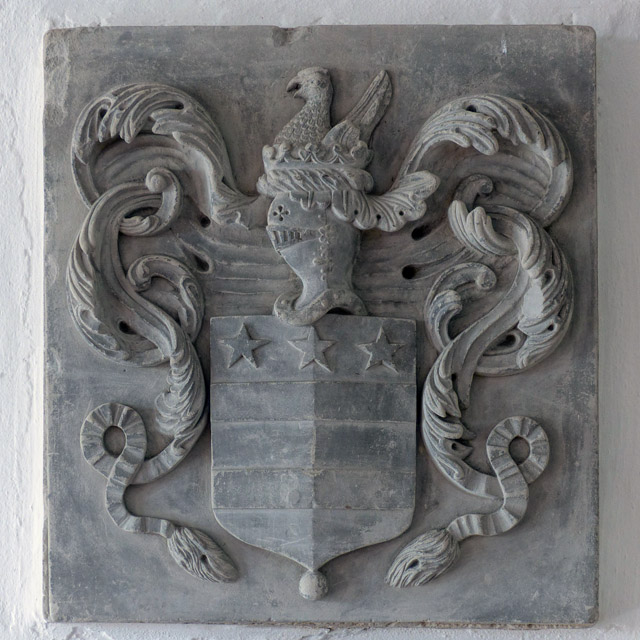
This carved stone panel bearing the arms of Sir John Washington of Thrapston (active in the late sixteenth century) provides a revealing example of how heraldry functioned as a durable language of identity, capable of moving across settings and generations while retaining its authority. Sir John Washington was the great-great-great uncle of George Washington, the first President of the United States, a connection that has given enduring historical resonance to the family’s English origins.
Although now displayed in the church at Thrapston, the arms were most probably not created for an ecclesiastical context. Documentary evidence places Sir John Washington at what later became known as Montague House, a domestic setting more typical for the permanent display of armorial sculpture asserting lineage, property, and social standing. The later presence of the panel in the church, accompanied by a small explanatory notice, suggests relocation rather than replication: a common fate for heraldic objects once their original domestic context was lost, altered, or reinterpreted.
In its original setting, the carving would have functioned as a statement of family identity, making lineage visible through heraldic form rather than inscription. In its later ecclesiastical setting, the same object acquires a different role: no longer an assertion of status within a household, it becomes an object of historical memory, requiring explanation for viewers no longer fluent in heraldic language. The addition of an interpretive label marks this shift from lived social practice to antiquarian understanding.
Seen within the broader context of heraldry in churches—alongside marriage shields in stained glass, armorials on tombs, and selected hatchments—the Washington arms illustrate how heraldic symbols could migrate between domestic, funerary, and ecclesiastical spaces, while continuing to serve as markers of continuity and belonging. Their survival reflects not only family prominence, but also later interest in lineage and historical association, particularly given the Washington family’s transatlantic significance.
This panel thus exemplifies heraldry not merely as decorative emblem, but as a persistent system of social memory, capable of outliving its original context and acquiring new meanings through relocation, reinterpretation, and display.