
Dunstable Priory
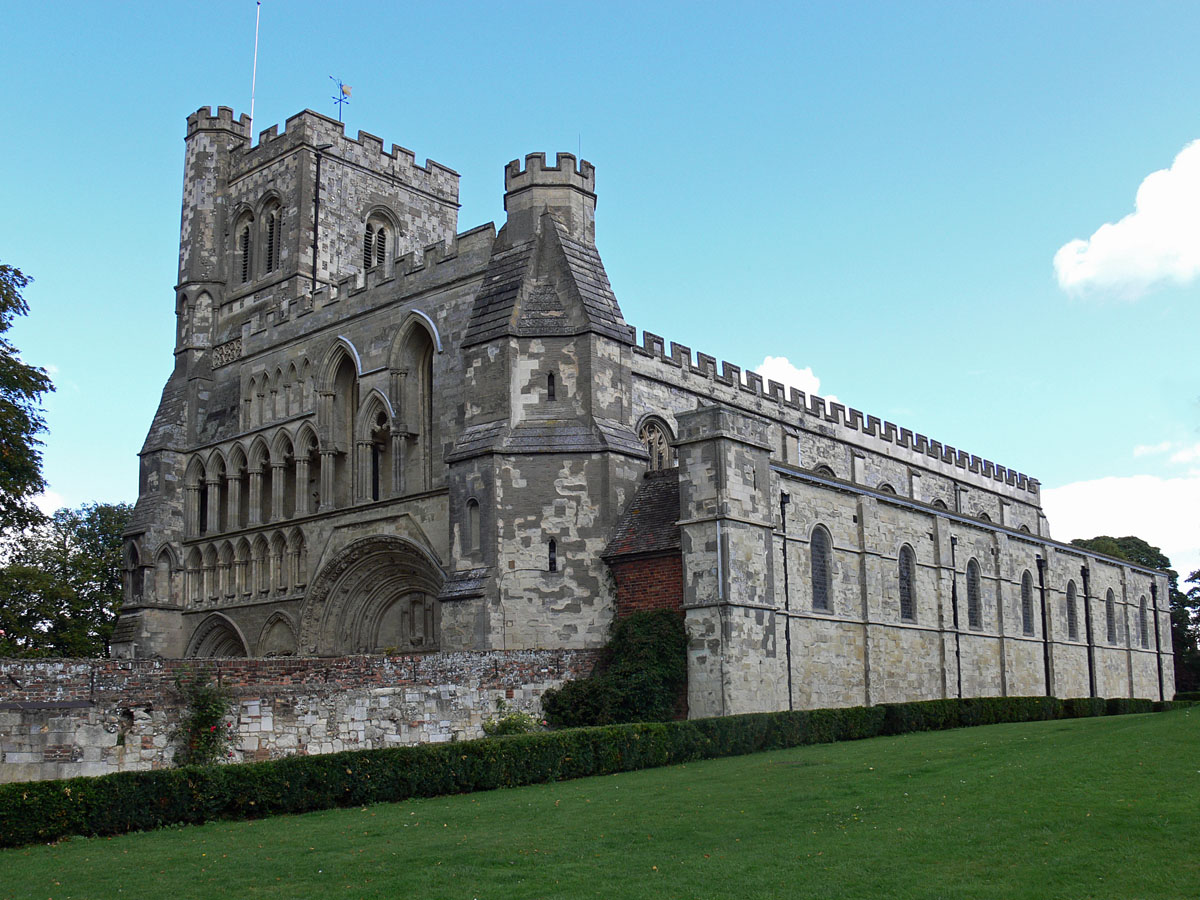
Dunstable Priory, formally the Priory Church of St Peter ⓘ, was founded c. 1131–1132 by Henry I as a house of Augustinian Canons. Strategically sited at the intersection of two major ancient routes—Watling Street and the Icknield Way—the priory occupied a key position within England’s medieval road network, a factor that profoundly shaped both its prosperity and the development of the surrounding town.
Foundation and medieval significance
The choice of Dunstable reflected royal policy as well as religious ambition. Augustinian houses were often placed at nodal points of travel and settlement, combining pastoral care, hospitality, and administrative reach. From its foundation, the priory became a religious, economic, and civic centre, exerting sustained influence over the growth of the town through landholding, markets, and ecclesiastical jurisdiction.
The priory church itself was conceived on a large and ambitious scale, appropriate to a royal foundation. Its nave, substantially complete by the mid-12th century, is one of the most imposing surviving examples of Romanesque architecture in southern England.
Architecture
What survives today is principally the nave of the former priory church, built in the Norman period and later enriched with Gothic additions. The most celebrated feature is the west front, a richly articulated Romanesque composition with tiers of blind arcading, sculpted capitals, and figural carving. This façade stands among the finest of its kind in England, combining architectural clarity with ornamental density.
Internally, the nave retains its powerful Norman character: massive piers, rounded arches, and a strong sense of rhythm and scale, later recalling Gothic refinements in details and fittings. Although the eastern parts of the church and the claustral ranges were lost after the Dissolution, the surviving structure still conveys the monumentality of the original complex.
Sculpture and timber decoration
The roof truss preserves a series of mid-15th-century carved oak Apostles, integrated into the timber roof as corbels supporting arched braces or hammer-beams. Conceived as both structural and symbolic supports, these figures formed part of an apostolic cycle appropriate to a ceremonial chapel within an Augustinian house. Originally polychrome, they belong to a wider tradition of late Perpendicular roof sculpture across the Midlands and East Anglia.
The Lady Chapel and the Reformation
Dunstable Priory occupies a central place in English history through events of 1533, when Thomas Cranmer, newly appointed Archbishop of Canterbury, convened a court in the Lady Chapel of the priory. There he pronounced the marriage of Henry VIII and Catherine of Aragon invalid. This ruling was a decisive moment in the English Reformation, directly precipitating the king’s break with Rome.
The choice of Dunstable for this judgment reflects the priory’s standing as a respected ecclesiastical institution with appropriate legal and ceremonial authority.
Dissolution and survival
The priory was formally dissolved in 1540 during the Dissolution of the Monasteries. Most of its monastic buildings—cloister, chapter house, and domestic ranges—were demolished or quarried for stone. The nave, however, was spared due to its continued use as the parish church, ensuring its survival when many comparable monastic churches were entirely lost.
Present role and significance
Today, the surviving church serves as the active parish church of St Peter, preserving a remarkable continuity of worship spanning nearly nine centuries. Architecturally, it stands as a major monument of Norman ecclesiastical design, while historically it is inseparable from the political and religious transformations of 16th-century England.
Dunstable Priory thus occupies a dual place in the English landscape: as a masterpiece of Romanesque architecture and as a site of national historical consequence, where royal policy, ecclesiastical authority, and architectural ambition converged.
