13th century

w.204 St Andrew and St John - Bourges Cathedral
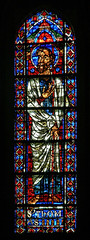
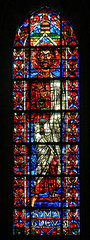
St John the Evangelist - Bourges choirWindow 204 consists of two tall lancets forming part of the celebrated early thirteenth-century clerestory glazing of Bourges Cathedral. The saints represented, Andrew on the left and John the Evangelist on the right, are shown as full-height standing figures beneath architectural canopies, framed by the characteristic geometric borders of the Bourges workshop.
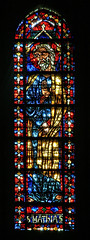
w.206 St James the Greater, St Philip, and St Thomas - Bourges Cathedral

St Thomas

Window w.206 forms part of the major early 13th-century glazing programme of the choir clerestory at Bourges Cathedral. Like the other apostolic lancets in this zone, it presents three full-length apostles standing beneath architectural canopies, each framed by the characteristic red–blue geometric borders of the Bourges workshop. The style, palette, and facial types align closely with the glazing campaigns dated to c.1210–1215.
w.208 The Apostles Bartholomew, Matthew, and Simon - Bourges Cathedral

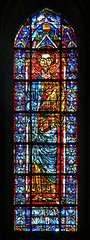
Saint Matthew

Window 208 forms part of the distinguished apostolic cycle that runs around the clerestory of Bourges Cathedral. It presents three standing apostles in individual lancets: St Bartholomew on the left, St Matthew in the centre, and St Simon on the right. Each is set before a deep blue background and surrounded by the richly coloured geometric border characteristic of the Bourges glazing workshop in the early thirteenth century.

w.210 James the Less, Barnabas, and Thaddeus - Bourges Cathedral

James the Less, Barnabas, and Thaddeus


Window w.210 forms part of the southern clerestory apostolic cycle of Bourges Cathedral. Created in the first decades of the 13th century, this scheme is contemporary with the cathedral’s great choir and represents one of the finest ensembles of High Gothic stained glass in France.

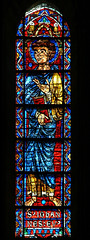
w.212 St Mark, St Luke, and St Matthias - Bourges Cathedral

Window w.212, located high in the south choir clerestory of Bourges Cathedral, dates from c.1210–1215 and belongs to the earliest glazing phase of the High Gothic choir. The window presents two Evangelists, Mark and Luke, and one Apostle, Matthias. 

This trio forms part of a wider apostolic–evangelist cycle distributed around the clerestory, each figure shown as a monumental standing saint set within a richly patterned Gothic frame.

Wall paintings at Burton Dasset

The church of All Saints as Burton Dassett in Warwickshire dates from the early C12 through to C13. The walls were plastered with 'daub', lime, chopped straw and animal hair and over which various wall painting have been executed. At various times over the centuries the paintings have been whitewashed over and replaced with new works. These include from the C13 depiction of the 'Doom' to  highly ornamented texts..


Walter de Cantilupe

Walter de Cantilupe was Bishop of Worcester from 1236 until his death in 1266 and a prominent ecclesiastical supporter of baronial reform in mid-13th-century England. Closely aligned with Robert Grosseteste, he opposed the appointment of foreign clerics to English benefices and defended episcopal autonomy against royal interference.

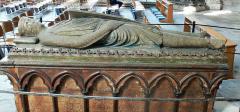
Walter de la Wyle

Walter de la Wyle

Walter de la Wyle rose from comparatively humble origins within the minor clergy of Salisbury to attain one of the most senior ecclesiastical offices in southern England. His election as bishop in 1263 was unusual in an age when episcopal sees were frequently dominated by nobles or royal administrators, and it reflected both the confidence of the cathedral chapter and the growing institutional independence of Salisbury.

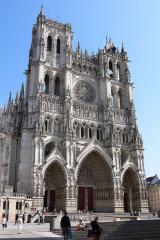
Western Facade - Amiens Cathedral

Western Facade - Amiens Cathedral

The western facade of the cathedral of Notre-Dame in Amiens contains 3 doorways. A central portal that opens into the nave, and two portals beneath the north and south towers that open into the cathedral's aisles. Above each portal is a tympanum the central one depicting the last Judgement, the northern one the transfer of the relics of St Firmin, and the south portal depicts the Virgin Mary .


Pages

Subscribe to 13th century