Anglo-Saxon Friezes from Breedon-on-the-Hill

Examples of the friezes and fragments of stone carvings from the 8th century Anglo Saxon monastery at Breedon-on-the-Hill.
Examples of the friezes and fragments of stone carvings from the 8th century Anglo Saxon monastery at Breedon-on-the-Hill.
Charlemagne, also known as Charles the Great, was King of the Franks from 768 and Emperor from 800 until his death in 814. His reign transformed the political landscape of western Europe and laid the foundations for the later Holy Roman Empire.
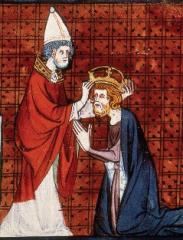
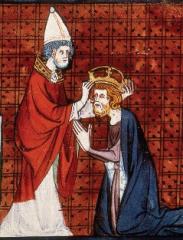
Pope Leo III served as pope from 795 until his death in 816. His pontificate is most closely associated with the coronation of Charlemagne ⓘ in 800, an event that reshaped the political order of western Christendom.
St Wilfrid (c. 634–709) was one of the most prominent and controversial figures of the early English Church. A bishop, reformer, and monastic founder, he played a central role in aligning the English Church with Roman ecclesiastical practice during the 7th century.
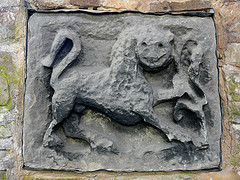
Striking animal reliefs, carved around 800 CE, are among the finest surviving examples of Anglo-Saxon sculpture from the Mercian kingdom. They were originally part of the 9th-century monastery at Breedon-on-the-Hill and are now set into the walls of the later Augustinian priory church of St Mary and St Hardulph.
 This relief belongs to the important group of Anglo-Saxon sculptures from Breedon-on-the-Hill, dating from the late eighth or early ninth century. Carved in local sandstone and set within a rectangular frame, it depicts two standing male figures rendered in high relief beneath an architectural arch. Both figures are shown in long, pleated garments and hold leaf-topped rods in their right hands, a detail that identifies them not as craftsmen or labourers, but as prophets or inspired teachers.