Elizabeth Verney - Norton, Northamptonshire

Memorial to Elizabeth Verney (d1633).
Memorial to Elizabeth Verney (d1633).
This monument is to Elizabeth Williams (d1622) who died in childbirth, an effigy of a baby in its chrisom shroud lies by her side. Her sister also died in childbirth a year later and a monument to her is nearby. Both monuments are probably the work of Samuel Baldwin of Stroud ⓘ.
The Emmaus window by Heaton, Butler & Bayne, created in 1925, is a stained-glass triptych set in a South chancel window at Market Bosworth. Made by the London firm known for its Victorian and Pre-Raphaelite style, it depicts the biblical Supper at Emmaus across three panels.
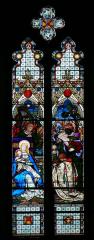
"Adoration of the Magi" by Heaton, Butler & Bayne (1869).
This four-light stained-glass window, installed in 1860, was designed by William Wailes and depicts the Four Evangelists beneath elaborate Gothic Revival canopies, with narrative predella scenes illustrating aspects of their ministry.
From left to right stand St Matthew ⓘ, St Mark ⓘ, St Luke ⓘ, and St John ⓘ, each identified by traditional attributes and haloed figures set within richly coloured architectural frameworks.
St Matthew holds a book, signifying his Gospel. In the predella below he is shown writing at his desk, emphasising authorship and divine inspiration.
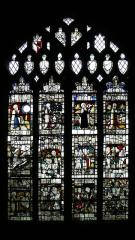
This window in the St Anne Chapel, Malvern Priory, has twelve scenes depicting the Creation story and the Fall. It is dated to between 1440-1450 and was probably the gift of Isabel Despenser and Richard de Beauchamp, 13th earl of Warwick.
The four panels in the bottom register of the window illustrates the expulsion from Eden.
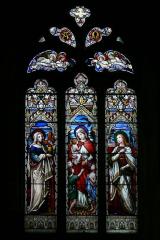
This three-light stained-glass window, dated 1881 and signed by Ward & Hughes ⓘ, is located in the church at Badby. It presents allegorical female figures embodying the three theological virtues: Faith, Charity, and Hope.
In the left-hand light, Faith stands holding a cross, symbol of belief in Christ’s redemptive sacrifice and the foundation of Christian doctrine. Her upright and composed stance reinforces the constancy traditionally associated with faith.
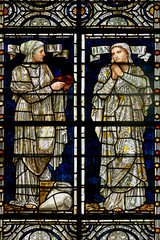
The four stained glass panels designed by Henry Holiday and made by James Powell & Sons (Whitefriars Glass) in 1891 form one of the most refined and spiritually resonant decorative ensembles in Salisbury Cathedral. Conceived as a unified series, they portray eight women of Scripture, Sarah and Hannah, Mary the Virgin and Mary the Mother of James, Mary of Bethany and Mary Magdalene ⓘ, and Ruth and Esther, each pair chosen to express a distinct yet harmonizing aspect of faith, devotion, and divine purpose.
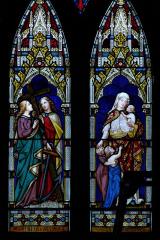
This two-light stained-glass window, dating to 1850, was made by Ward & Hughes ⓘ for the church at Litchborough. It presents allegorical female figures representing the three theological virtues: Faith, Hope, and Charity.
Faith, Hope, and Charity by Heaton, Butler & Bayne (1896). Staverton.