
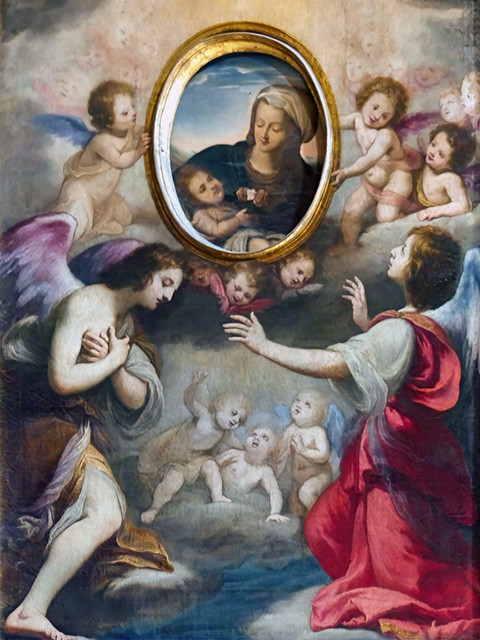
This devotional painting by Francesco Boschi ⓘ was executed in 1642–1643 for the church of Santi Michele e Gaetano. It was completed shortly after Lorenzo Lippi finished the upper decoration of the chapel, situating Boschi’s contribution within a coordinated decorative programme.
An early work, it shows the influence of his uncle and teacher Matteo Rosselli, particularly in its clarity of design, soft modelling, and devotional restraint.
Description
At the centre, within a gilded oval frame, the Virgin inclines her head toward the Christ Child resting across her lap. Their calm interaction forms the visual and theological focus of the composition.
Surrounding this medallion is a throng of angels and putti. Some kneel in adoration, others hover among softly rendered clouds, and several playful figures gather below. Their upward gestures and converging gazes direct attention to the Virgin and Child.
The contrast between the serene central image and the surrounding animation creates a balanced Baroque effect. The oval format suggests a revealed vision, contained yet radiant.
Style and Artistic Context
Boschi’s early style reflects the Florentine tradition shaped by Matteo Rosselli. The figures retain:
-
Firm, controlled drawing
-
Gentle transitions of light
-
Measured emotional expression
-
Harmonious colour
Unlike the heightened drama of Roman Baroque painting, Boschi’s approach remains composed and devotional. The emphasis is on clarity and reverent contemplation rather than theatrical intensity.
The painting forms part of a broader seventeenth-century decorative campaign within the church, aligning with Lorenzo Lippi’s work in the upper chapel and contributing to a unified spiritual programme.
Iconography
-
Virgin and Child: Centre of Marian devotion.
-
Angelic host: Affirmation of divine glory.
-
Putti: Emblems of innocence and celestial joy.
-
Gilded oval frame: A sacred image presented as vision.
While conceived as a Marian vision of heavenly praise, the clustered putti also resonate with Florence’s longstanding culture of care for abandoned children, a civic ideal embodied in institutions such as the Ospedale degli Innocenti.
