
Walter de la Wyle
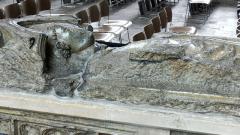
Walter de la Wyle rose from comparatively humble origins within the minor clergy of Salisbury to attain one of the most senior ecclesiastical offices in southern England. His election as bishop in 1263 was unusual in an age when episcopal sees were frequently dominated by nobles or royal administrators, and it reflected both the confidence of the cathedral chapter and the growing institutional independence of Salisbury.
Episcopate and architectural legacy
Walter’s episcopate is most closely associated with the development of the cathedral precinct of Salisbury Cathedral. His most enduring contribution was the donation of land that made possible the construction of the cathedral cloisters. Completed in the later 13th century, these became the largest stone-vaulted cloisters in England and a defining achievement of Early English Gothic architecture.
The cloisters’ disciplined geometry, refined proportions, and structural clarity reinforced Salisbury’s reputation as a model of architectural coherence. Walter’s patronage thus extended beyond practical endowment to shaping one of the most influential architectural ensembles of medieval England.
Political context and the Second Barons’ War
Walter’s career unfolded during a period of acute political instability. He aligned himself with the episcopal faction sympathetic to the baronial reform movement during the Second Barons’ War ⓘ, opposing the policies of Henry III. Following the royalist victory at the Battle of Evesham in 1265 and the death of Simon de Montfort, Walter came under suspicion as a former supporter of the defeated cause.
Despite this, he successfully negotiated his restoration to royal favour. By paying a substantial fine of £200, he secured permission to resume his episcopal functions and, by 1266, was restored to full standing. He subsequently participated in the Parliament of Kenilworth, which sought to heal the divisions left by the conflict and reintegrate former opponents of the crown.
Significance
Walter de la Wyle stands as a figure emblematic of the professionalisation of the English episcopate in the 13th century: a bishop shaped by cathedral culture rather than aristocratic lineage, whose legacy lies as much in architectural patronage as in political survival during one of the most turbulent decades of Henry III’s reign.