Renaissance

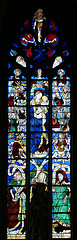
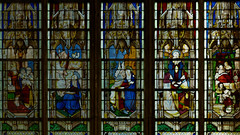
Life of St Anne and St Joachim

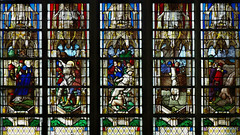
This window narrates episodes from the apocryphal infancy cycle concerning St Anne and St Joachim, parents of the Virgin Mary. Executed in the early sixteenth century by a Rouen workshop, the glass combines dense architectural canopies with clear, compartmentalised scenes, allowing the viewer to follow the story across multiple lights.
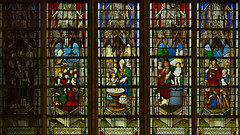
Life of St Austremoine

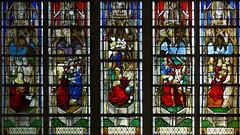
This window forms part of the late-medieval glazing cycle devoted to St Austremoine (St Austremonius), traditionally regarded as one of the missionary bishops sent from Rome to evangelise Gaul. The panels adopt the rich narrative style characteristic of Rouen workshops in the early sixteenth century, combining brightly modelled figures, deep architectural canopies, and landscape backdrops that open the narratives into broad, coherent sequences.


Life of St Catherine

This window (c1508) depicts key moments from the life and martyrdom of St Catherine of Alexandria, a learned noblewoman whose legend was widely celebrated in late-medieval Europe. The glazing, produced by a Rouen workshop in the early sixteenth century, follows the characteristic format of the Saint-Ouen cycles: tightly framed narrative scenes beneath elaborate Gothic canopies, enriched with vivid colour and detailed architectural settings.

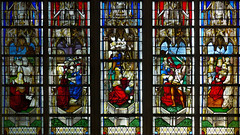
Life of St Vincent

This window (c1550) illustrates episodes from the martyrdom of St Vincent of Saragossa, one of the most widely venerated deacons of the early Church. Created by a Rouen atelier in the early sixteenth century, the glass adopts the familiar layout of the Saint-Ouen narrative series: scenes arranged beneath richly architectural Gothic canopies, each panel presenting a distinct moment from the saint’s Passion.


The south aisle of the nave at Saint-Ouen preserves one of the most varied yet coherent hagiographic ensembles in the church’s glazing programme. Although the windows today comprise mixtures of sixteenth-century fragments, nineteenth-century architectural refitting, and extensive twentieth-century restoration, they collectively articulate a single, sustained theme: the commemoration of exemplary saints whose lives, virtues, and martyrdoms offered models for Christian devotion.

Pages

Subscribe to Renaissance