East Window - Misterton Leicestershire

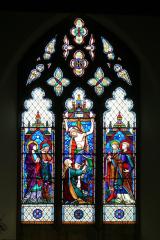
This 5 light east window at St. Leonard, Misterton in Leicestershire is dated 1870.
This 5 light east window at St. Leonard, Misterton in Leicestershire is dated 1870.
A richly coloured Crucifixion window of 1868–1869 by Heaton, Butler and Bayne, presenting the central mystery of the Passion within a balanced devotional scheme.
Left-hand light:
The Virgin Mary ⓘ stands with Mary Cleophas, their restrained grief expressed through gesture and posture, forming a quiet counterpoint to the drama of the central scene.
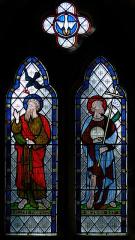
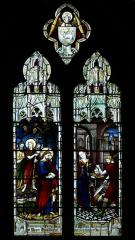
This two-light stained-glass window, dating from the late 1860s, was made by Clayton & Bell ⓘ for the church at Tiffield. It pairs figures of the Old and New Testaments: Elijah the Prophet and St John the Baptist ⓘ, linked typologically through their prophetic witness and ascetic character.
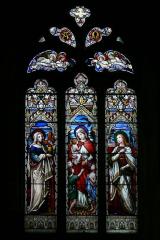
This three-light stained-glass window, dated 1881 and signed by Ward & Hughes ⓘ, is located in the church at Badby. It presents allegorical female figures embodying the three theological virtues: Faith, Charity, and Hope.
In the left-hand light, Faith stands holding a cross, symbol of belief in Christ’s redemptive sacrifice and the foundation of Christian doctrine. Her upright and composed stance reinforces the constancy traditionally associated with faith.
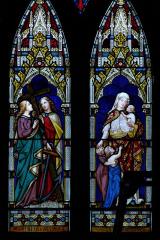
This two-light stained-glass window, dating to 1850, was made by Ward & Hughes ⓘ for the church at Litchborough. It presents allegorical female figures representing the three theological virtues: Faith, Hope, and Charity.
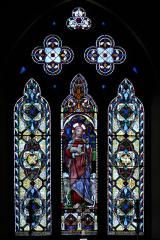
This three-light stained-glass window of 1873, made by Jones & Willis, is located in the church at Tiffield. The composition centres upon Christ as the Good Shepherd, framed by richly ornamented geometric glazing.
A narrative stained-glass window of 1885 by Burlison & Grylls ⓘ occupies the east bay of the north aisle.
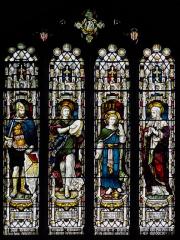
This four-light window of 1895, at All Saints Stamford, executed by Heaton, Butler & Bayne, depicts four Old Testament figures associated with leadership, praise, and faithful dedication: Joshua, Miriam, Samuel ⓘ, and Hannah.
From left to right:
Joshua, warrior and successor of Moses, stands armed, bearing sword and shield, representing steadfast obedience and divine commission.
Miriam, sister of Moses, holds a tambourine, recalling her song of triumph after the crossing of the Red Sea (Exodus 15).
Installed in 1889 as the Groves memorial, this three-light window depicts a scene from the life of King David ⓘ, accompanied by the inscription: “And the king stood by the gate side” (2 Samuel ⓘ 18:4).
In the central light, David stands beneath a fortified gateway as a kneeling warrior receives instruction. The scene evokes the moment before battle, when the king publicly charges his forces. The composition emphasises solemn command and moral gravity.
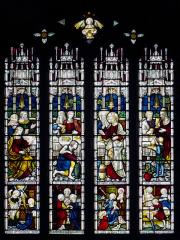
This four-light window, at All Saints Stamford, depicts The Marriage at Cana (John 2:1–11), the first miracle of Christ. Executed by Clayton & Bell ⓘ in the late nineteenth century, it combines the Cana narrative with a Marian-inflected Christological cycle in the predella below.
In the main lights, Christ stands centrally, blessing the water jars as servants draw the newly transformed wine. Mary gestures toward her Son, echoing her words: “Whatsoever he saith unto you, do it.” The surrounding guests express surprise and animation as the miracle unfolds.