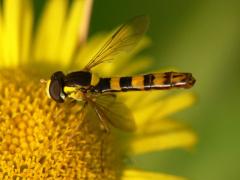
Flies in the family Syrphidae. They are often seen hovering or sipping nectar at flowers; the adults of many species feed mainly on nectar and pollen, while the larvae eat a wide range of foods.
Flies in the family Syrphidae. They are often seen hovering or sipping nectar at flowers; the adults of many species feed mainly on nectar and pollen, while the larvae eat a wide range of foods.
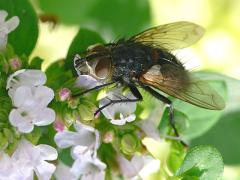
This the second largest family of flies with 8,200 species. All are parasitoids (the larvae develop inside a living host, ultimately killing it), and a few that are parasitic (do not kill the host).
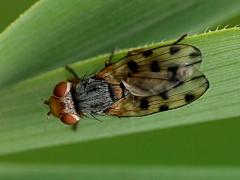
Tephritidae is one of two fly families referred to as "fruit flies".
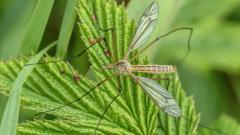
Tipulidae is a family of files commonly called cranefiles.
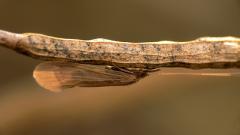
Divided into 45 families,with some 12,000 species and 600 genera, the Trichoptera or caddisflies are one of the most diverse orders of aquatic insects. They are closely related to the Butterflies and Moths (Lepidoptera) with the Trichoptera having the more primitive characteristics. Some caddis flies can be confused with some species of moths, but the wings of the caddisfly is hairy not scaled as with moths. The name Trichoptera comes from the Greek trich, "hair" + ptera, "wings".