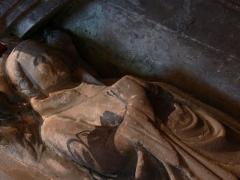
Effigy of Priest - Aston-le-Walls, Northamptonshire
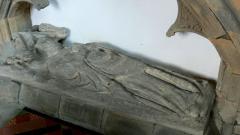
C14 effigy of priest in tomb recess.
C14 effigy of priest in tomb recess.
Mid C14 recumbent effigy of a priest in tomb recess.
This mid-14th-century fresco by Dalmasio degli Scannabecchi depicts the reluctant election of Gregory the Great ⓘ as pope.
According to tradition, Gregory attempted to avoid the office out of humility. A divine sign revealed his location and confirmed the will of God. The episode presents sanctity expressed through reluctance rather than ambition.
Gregory stands at the left, separated from the assembled group. A vertical shaft of light descends toward him and marks divine approval.
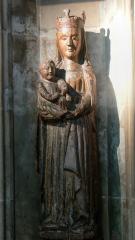
This wooden sculpture of the Virgin and Child, dating to the fourteenth century (most probably the mid to late 1300s, though sometimes described as early fifteenth century), is of Continental—likely French—origin.

Gilbert de Clare, 5th earl of Gloucester, and his father Richard de Clare, were among the 25 barons who pledged to enforce the provisions of the Magna Carta, as a result both were excommunicated by Pope Innocent III ⓘ.

Gilbert de Clare (d1295) was the 7th Earl of Gloucester having succeeded to the Earldom in 1262. Gilbert and his brother Thomas first supported Simon de Montfort's rebellion against Henry III, but later changed sides.

Gilbert de Clare, 8th earl of Gloucester, was a strong supporter of Edward II and fought with him at the Battle of Bannockburn on the 24th of June 1314 where he was killed aged 23. He was also one of the Lords ordainers that in 1311 ordered the expulsion of his brother-in-law Piers Gaveston who was Edward's favourite.
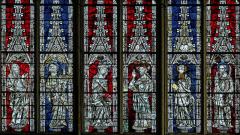
The east window at Gloucester Cathedral was created as part of the rebuilding of the abbey church of St Peter ⓘ. Built in the Perpendicular style it was the largest window in Europe. The decorative scheme portrays the Coronation of the Virgin and the glass mostly dates from the 1350s.

Stained glass panel (1338-1340) depicting Hugh Despenser the Younger who was married to Eleanor the sister of Gilbert de Clare. Hugh Despenser became the favourite of Edward II but was especially disliked by Queen Isabella, and executed when Edward II was deposed in 1326.
After the execution of Hugh Despenser his remains were gathered together and buried here in Tewkesbury. The tomb once contained over 40 statues, all of which have now gone. The current tomb in the alcove is that of Abbot John Cotes (d1337) which was moved into this location in the 17th century.